
After years of “harsh” treatment Tether finally convinces ‘Big Four’ firm to audit USDT

For years, the shortest line of attack against Tether was the demand for a full independent audit.
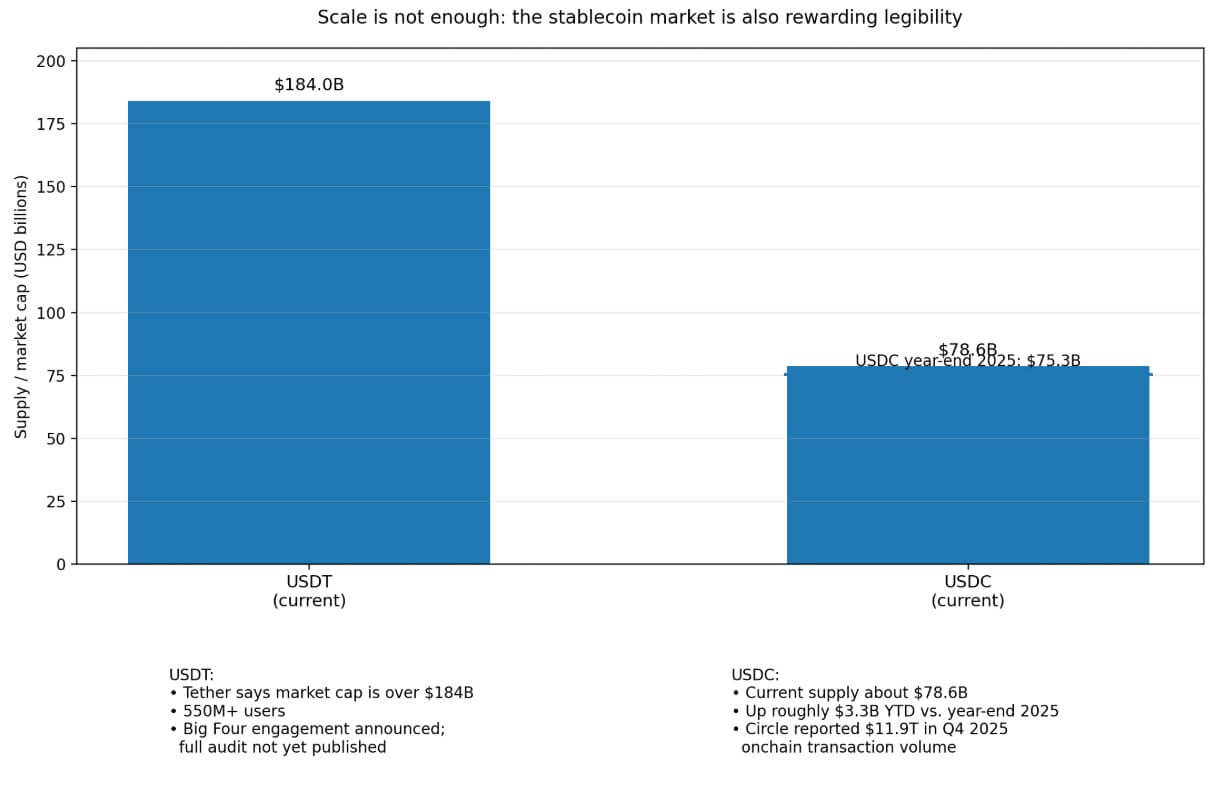
The audit never came, and the company absorbed the reputational cost without visible damage to its position. USDT crossed $184 billion in market capitalization, reached more than 550 million users, and became the dominant liquidity layer across global crypto markets.
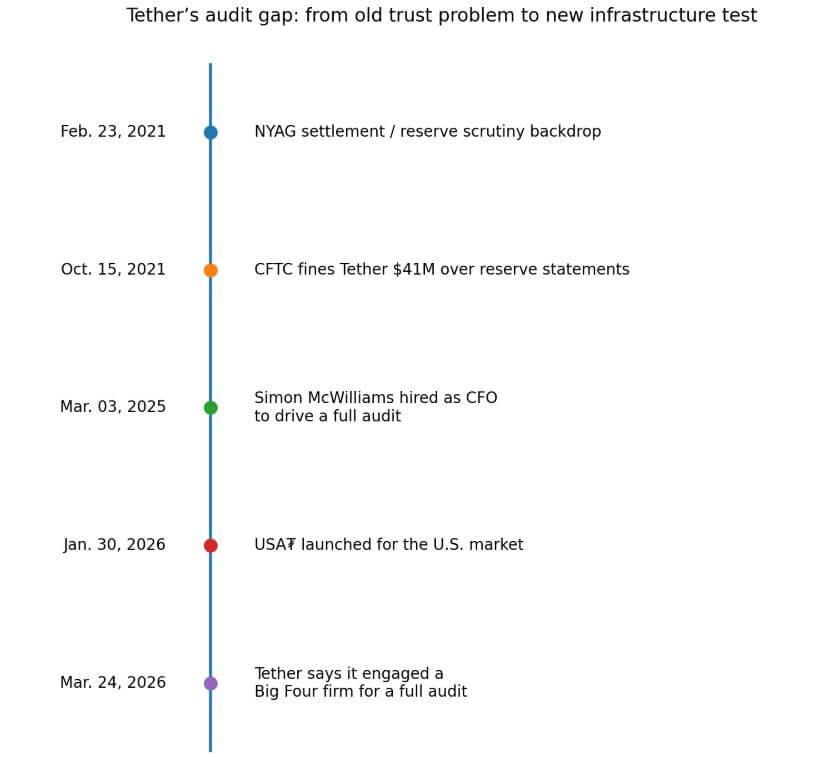
On Mar. 24, Tether announced it had formally engaged a Big Four firm for its first full independent financial statement audit.
This came after Tether CEO Paolo Ardoino told CryptoSlate’s Editor-in-Chief almost 2 years ago that he was actively trying to get a ‘Big Four’ firm on board, but that he felt the political and regulatory climate in the US was making it extremely challenging. According to him, the lack of a ‘Big Four’ audit was not due to a lack of trying from Tether.
At the time, he said regulatory pressures, such as Senator Warren’s call for auditors to avoid crypto companies, made it difficult for Tether to secure a full audit from a Big Four firm. He expressed confidence in Tether’s ongoing efforts to prove its legitimacy and financial health, which appear to be finally coming to fruition.
Speaking on the ‘risk’ for an auditor to take on Tether as a client, and failed attempts to bring on a ‘Big Four’ firm after “harsh” treatment from US legislators, he said,
“Look, really openly doing attestation on a stablecoin, especially if the stablecoin is named Tether, of course brings a lot of attention and a lot of risk management. Rightfully so, right? […]
We tried to get a Big Four auditor to the full audit… it’s still our top priority.”

👀 @paoloardoino, CEO of @Tether_to, talks to @CryptoSlate‘s @akibablade & @jvs_btc in his most transparent & open interview to date.
Paolo reveals info on inner working of Tether’s audits, competition, FUD, and where Tether has been naive over the years.
🚨 MUST WATCH 🚨 pic.twitter.com/FZcLJO4tM0
— CryptoSlate (@CryptoSlate) June 28, 2024
The debt that never cleared
The historical record gave Tether’s critics seemingly durable ammunition.
In 2021, the CFTC ordered the company to pay $41 million for misleading statements claiming that US dollars fully backed USDT.
The New York attorney general said Tether and Bitfinex made false statements about reserves while concealing roughly $850 million in losses. Those findings left Tether carrying a trust discount that quarterly attestations never fully retired, even as USDT supply kept climbing.
Tether’s public preparations for this announcement date back at least a year, while Ardoino’s comments suggest it goes back even further.
In March 2025, the company hired Simon McWilliams as CFO with an explicit mandate to drive a full audit, framing that work as part of a broader push into the institutional financial system.
The Mar. 24 announcement is the first concrete sign that the effort advanced to formal engagement.
The company itself drew the relevant line, saying that attestations represent the current standard across stablecoins and the audit moves it “beyond this benchmark.”
That framing is a direct acknowledgment that the benchmark is no longer sufficient for the company’s desired trajectory.
The plumbing is being built around them
The urgency behind Tether’s audit push becomes clearer when mapped against what major financial institutions are now building.
DTCC announced that NSCC plans to begin 24×5 trade processing on June 28, pending regulatory approval, calling it a foundational step toward a more continuous market.
NYSE is designing a tokenized venue built around 24/7 operations, instant settlement, and stablecoin-based funding.
Nasdaq has pitched tokenization as the path to an “always-on financial ecosystem.” BMO, CME Group, and Google Cloud announced a tokenized cash platform to enable institutional clients to move value continuously for margin, collateral, and settlement.
That constellation of announcements describes a market reorganizing around continuous operation and tokenized dollar movement.
| Institution / project | What is being built | Why it raises the bar for stablecoins |
|---|---|---|
| DTCC / NSCC | 24×5 trade processing and longer-hour market infrastructure | Longer trading windows increase the need for dollar instruments that can move reliably outside traditional banking hours |
| NYSE tokenized platform | A venue designed around 24/7 operations, instant settlement, and stablecoin-based funding | Stablecoins are being pulled closer to core funding and settlement functions rather than remaining just exchange liquidity tools |
| Nasdaq tokenization push | An “always-on financial ecosystem” built around tokenized financial assets | Stablecoins are increasingly judged on whether they can function inside a continuous, interoperable capital-markets environment |
| BMO / CME Group / Google Cloud | Tokenized cash for real-time margin, collateral, and settlement workflows | If stablecoins or tokenized dollars are used for margin and collateral movement, reserve quality and auditability become more important |
| Stablecoin issuers generally | A shift from crypto trading collateral toward settlement-grade cash rails | The closer stablecoins get to market plumbing, the less tolerance institutions have for unresolved transparency questions |
| Market implication | Stablecoins competing to be the trusted “cash leg” in tokenized markets | Winners are likely to be judged not only by scale, but by how easily counterparties, venues, and institutions can diligence and integrate them |
DTCC’s own materials carefully distinguish 24×5 from 24×7 and describe the transition as staged.
The bar is rising in ways that make the identity of the dollar token more consequential than it was when stablecoins existed primarily to fund crypto trades.
In a market where NYSE explicitly envisions stablecoin-based funding and BMO is building infrastructure for real-time margin and collateral movement, counterparties will ask harder questions about reserve quality and auditability.
A stablecoin used as settlement-grade money faces a different level of scrutiny than one used to move between exchange accounts.
What institutional legibility can buy
Circle’s numbers offer the clearest available evidence of what happens when a stablecoin makes itself easier for institutions to understand and audit.
Circle reported $75.3 billion in USDC circulation at year-end 2025 and $11.9 trillion in on-chain transaction volume in the fourth quarter of 2025.
Current supply is around $78.6 billion, implying roughly $3.34 billion in year-to-date growth in 2026, and that growth reflects multiple factors.
USDC works best here as an illustration of what institutional legibility can unlock.
The more useful observation is that the market has already demonstrated that compliance, clearer reserve disclosure, and easier institutional integration can translate into meaningful scale.
Tether’s audit push reads as a bid to access the same pool of institutional demand, and the January launch of USA₮ reinforces that reading.
Anchorage Digital Bank issues USA₮ for the US market, with Cantor Fitzgerald serving as the reserve custodian and preferred primary dealer, while USD₮ continues to be issued globally.
That architecture looks like an early attempt to restructure for a world where different markets apply different standards to stablecoin issuers.
A qualification play
In the bull scenario, Tether delivers a clean full audit and uses that result to close its institutional trust gap precisely as tokenized securities, 24×5 clearing, and tokenized cash networks move from announcement to operation.
The audit becomes the qualifying step that keeps USDT relevant to the next generation of market infrastructure.
The supporting evidence is the number of major incumbents already laying the rails: DTCC, NYSE, Nasdaq, BMO, CME, and Google Cloud are all building toward a more continuous, tokenized market, and each of those projects needs a credible dollar leg.
In the bear case, the audit drags, and the firm stays unnamed. No timetable surfaces.
In that scenario, marginal institutional flows continue to move toward issuers that are already easier to diligence, as well as toward bank-linked tokenized cash systems that carry an implicit reserve guarantee through their issuing institution.
USDT maintains its grip on crypto-native liquidity, but Tether is excluded from the more regulated settlement workflows that the largest incumbents are building.
That outcome is more plausible than it was two years ago, precisely because NYSE and BMO are designing infrastructure with explicit stablecoin-funding components, creating real switching costs for stablecoin issuers that cannot clear institutional due diligence.
Tether’s real audience for this announcement may be the next generation of operators, such as clearing firms, broker-dealers, tokenized securities platforms, and exchange operators, who are now deciding which dollar tokens can be integrated into their infrastructure.
The missing audit is becoming a qualification problem in a market where stablecoins are being evaluated as candidates for the dollar leg of continuous clearing, real-time margin, and always-on settlement.
The oldest unanswered question about the world’s largest stablecoin carries a different kind of cost than it did when the stakes were limited to crypto exchange liquidity.
Tether’s announcement is the first step toward closing that gap.
Credit: Source link