
CFTC sues 3 states in bid to redefine crypto prediction markets as federal products

Washington has escalated its fight with states over prediction markets, launching lawsuits that could decide whether these platforms operate as national financial products or state-regulated gambling. The outcome will determine if sports contracts can scale or get forced back into local licensing regimes.
On Apr. 2, the Commodity Futures Trading Commission (CFTC) sued Arizona, Connecticut, and Illinois, with the Department of Justice as a litigation partner.
The regulator demanded expedited rulings that federal derivatives law preempts state efforts to classify event contracts as illegal gambling.
Washington moved to the offensive, trying to establish, as a matter of national market structure, that these products belong under exclusive federal jurisdiction.
Why this matters: This is no longer a niche regulatory dispute. The CFTC is asking courts to confirm that once an event contract is listed on a federally regulated exchange, states lose the ability to shut it down as gambling. If that argument holds, prediction markets become a national product category. If it fails, operators face a fragmented system where their most valuable contracts, especially sports, must comply with dozens of state regimes.
The CFTC’s published FAQ makes the ambition explicit. The suits are registrant-agnostic, deliberately detached from any individual company’s fact pattern so that courts can rule on the preemptive scope of the Commodity Exchange Act itself.
Washington wants category-wide declarations on CEA preemption, binding regardless of which operator or exchange triggers enforcement.
The CEA’s exclusive jurisdiction provision is the lever.
The CFTC’s theory holds that once an event contract is listed on a CFTC-regulated exchange, states cannot relabel it as unlawful gambling without destabilizing the uniform national derivatives framework, potentially opening the door for states to assert authority over other exchange-traded derivatives that have operated without controversy for decades.
That framing becomes sharper against the legal map heading into April.
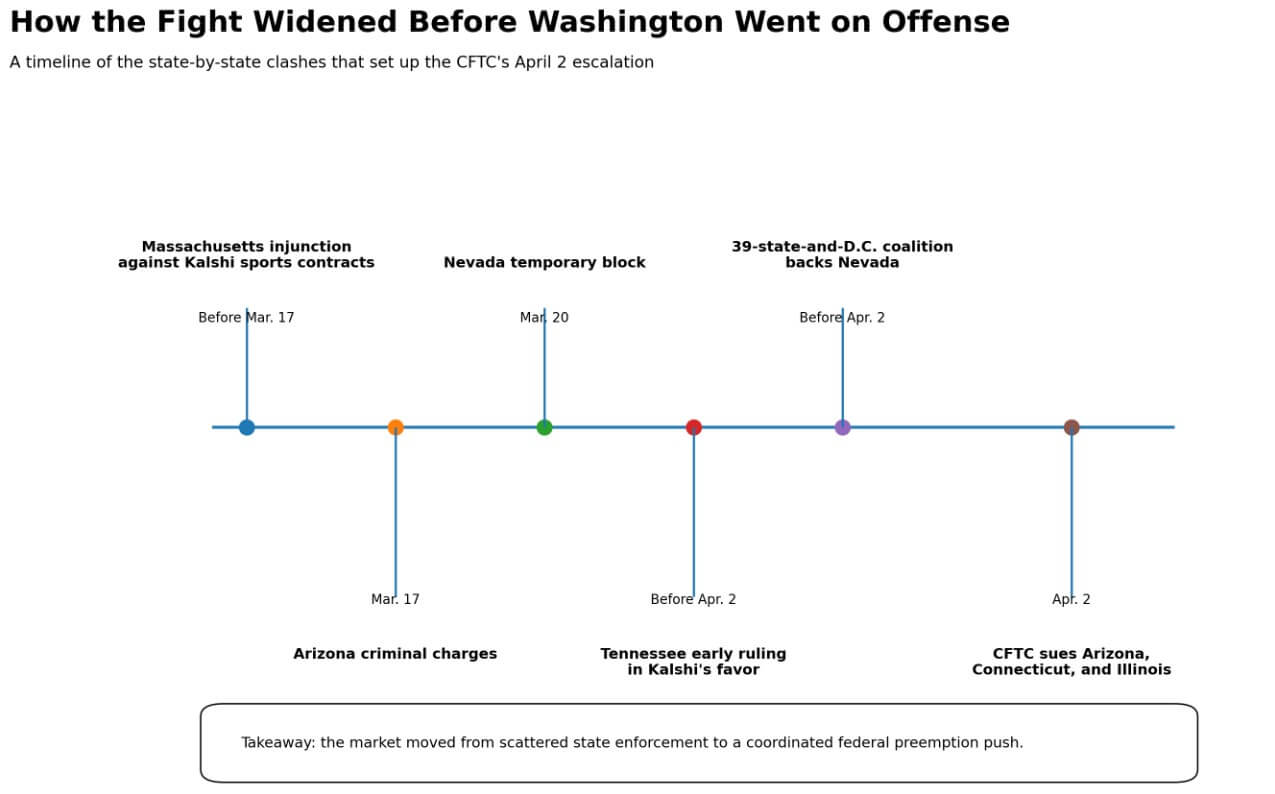
Massachusetts had secured an injunction against Kalshi’s sports contracts, and Nevada won a temporary block on Mar. 20. Arizona escalated to criminal charges on Mar. 17. Tennessee produced an early ruling in Kalshi’s favor. A 39-state-and-DC coalition filed amicus briefs backing Nevada.
The prediction market category was surviving on patchwork, while the CFTC played defense from the sidelines.

Sports as the fault line
Sports contracts are where the category stops looking like abstract forecasting and starts colliding with the full compliance architecture states built since the Supreme Court’s 2018 Murphy decision. The structure consists of licensing, age verification, KYC and AML protocols, self-exclusion databases, suspicious-wager reporting, and integrity monitoring.
Illinois told the CFTC that these platforms entirely bypass its licensing, responsible-gaming, AML, and tax regimes. Connecticut pointed to under-21 access that no licensed operator could legally offer.
The American Gaming Association translated those gaps into fiscal terms, claiming that sports bets on prediction markets have cost states more than $620 million in lost gaming taxes since the start of 2025.
The advocacy estimate converts legal theory into budget politics at a moment when the US sports betting revenue, which reached $1.61 billion in January 2026 alone, shows a market with year-over-year handle declines and incumbents with clear motivation to fight back.
| Regulatory feature | State-licensed sportsbook | Prediction market sports contract | Why states care |
|---|---|---|---|
| Licensing | Must hold a state sports-betting license | Operates under CFTC exchange framework rather than state gaming license | States argue this bypasses the licensing gate they use to control market access |
| Minimum age | Usually restricted to 21+ | Connecticut argued these contracts allowed under-21 participation | Creates a direct conflict with state consumer-protection rules |
| KYC / AML controls | Built into state gaming compliance regime | Illinois argued prediction markets bypass its KYC and AML regime | States see this as a gap in anti-fraud and anti-money-laundering oversight |
| Responsible-gaming rules | Required by state law and regulation | Illinois said these platforms bypass responsible-gaming requirements | States view this as a loss of problem-gambling safeguards |
| Self-exclusion tools | Standard feature in licensed betting markets | Not clearly embedded in the same state-run structure | Weakens the player-protection system states built after sports-betting legalization |
| Suspicious-wager reporting | Expected within sportsbook integrity frameworks | Not described in the article as operating under equivalent state rules | States and leagues worry about manipulation and detection gaps |
| Integrity monitoring | Conducted through state, operator, and league coordination | NBA and MLB argued the oversight framework is not comparable to licensed sportsbooks | Sports contracts are where market integrity concerns become hardest to ignore |
| League information-sharing | Common in regulated sportsbook ecosystems | CFTC only recently created a formal channel via its Mar. 19 MLB MOU | Shows the federal framework is still building tools states already expect |
| Taxes / fees | Operators pay state taxes and licensing fees | AGA says sports bets on prediction markets have cost states more than $620 million in lost gaming taxes since the start of 2025 | Turns the dispute from legal theory into a state-budget fight |
The leagues arrived as actors with a concrete grievance and a clear agenda.
The NBA said sports prediction markets were expanding into single-game contracts through self-certification, without anything resembling the oversight framework states require of licensed sportsbooks.
MLB pressed the same argument directly with the CFTC. On Mar. 19, the agency signed a memorandum of understanding with the league, establishing the first formal agency-league information-sharing channel around baseball-related contracts.
That MOU is both a practical integrity measure and an acknowledgment that the current framework carries a meaningful gap that the litigation leaves open.
The regulator’s internal contradiction
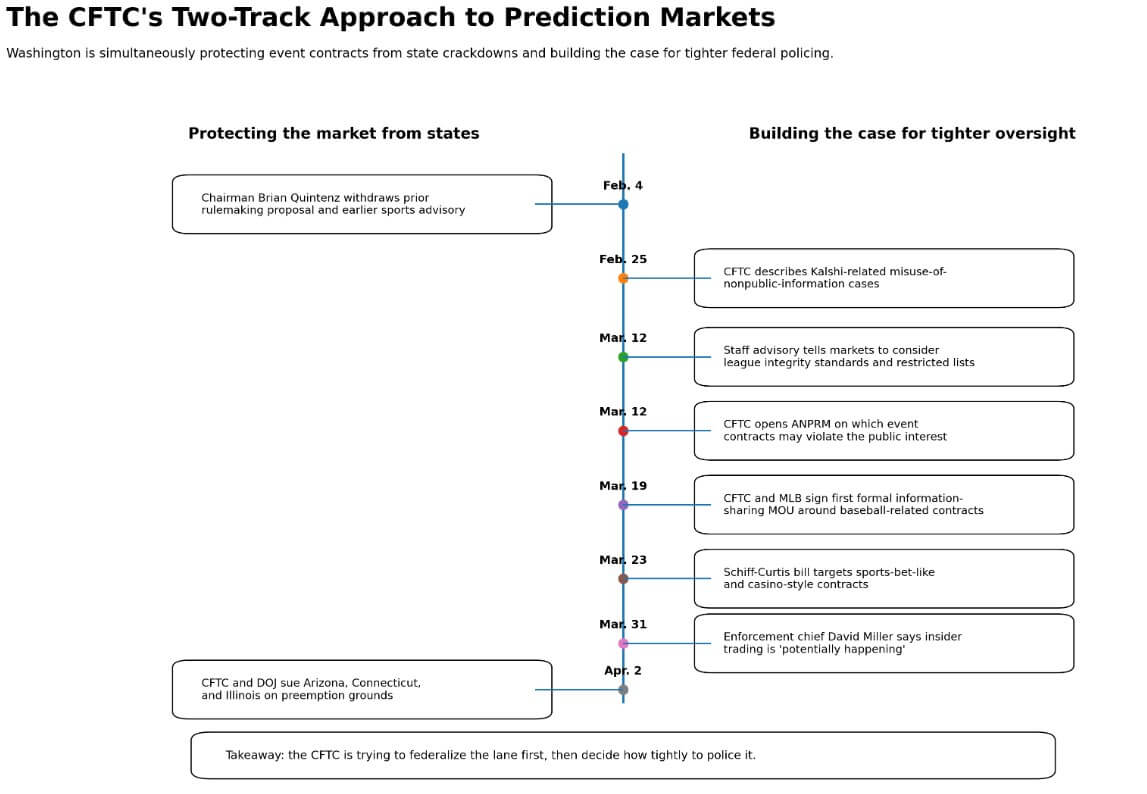
The CFTC is simultaneously trying to lock states out of the lane and build the public record that the lane requires far tighter policing.
On Feb. 4, Chairman Brian Quintenz withdrew a prior event-contract rulemaking proposal and an earlier sports advisory, framing the move as a permissive opening for the category. Within weeks, the agency moved in the opposite direction on nearly every other front.
On Feb. 25, the CFTC publicly described two Kalshi-related misuse-of-nonpublic-information cases, imposed penalties and multi-year suspensions, and stated that insider trading, wash trading, fraud, and manipulation rules fully apply to prediction markets.
On Mar. 31, enforcement chief David Miller said insider trading is “potentially happening” in these markets, citing injury-related and person-specific contracts as obvious integrity risks.
On Mar. 12, a staff advisory directed designated contract markets to consider league integrity standards, restricted-participant lists, and cooperation with league investigations. On the same day, the agency opened an advance notice of proposed rulemaking seeking input on which event-contract types may run contrary to the public interest.
Congress arrived in the same space on Mar. 23, when Senators Adam Schiff and John Curtis introduced the Prediction Markets Are Gambling Act, targeting contracts that resemble sports bets or casino-style games on CFTC-registered platforms.
The fight now runs in three venues at once: state courts, federal courts, and the Senate.
In the bull case, Washington’s suits in Illinois and Connecticut produce fast rulings endorsing the preemption theory, and a federal circuit affirms that the CEA displaces state gambling law for exchange-listed event contracts.
States lose the tools to block platform expansion, and the Schiff-Curtis bill stalls. Prediction market operators build sports offerings under a federal compliance wrapper consisting of league MOUs, restricted-participant lists, and whatever tighter rulebook emerges from the CFTC’s ANPRM process.
The category survives in sports as a regulated national market with a heavier obligation stack than operators currently carry. Developer incentives skew toward exchanges already holding CFTC registration rather than new entrants, compressing the number of platforms that can realistically compete.
In the bear case, state-favorable reasoning from Nevada and Massachusetts spreads at the appellate level.
Courts find that Murphy-era state sports-betting frameworks constitute the kind of traditional police power that federal preemption cannot readily displace.
Congress advances a carveout that pushes platforms listing sports contracts into state licensing processes. Political, macro, and business-event contracts, categories without a natural state-regulatory home, clear the bar more easily, while sports-adjacent contracts migrate toward the same licensing, tax, and integrity regime as conventional sportsbooks.
Operators who built their growth story around sports face a product retreat or a compliance restructuring that they did not price into their models.
The federal bet
Washington is wagering that “listed on a CFTC-regulated exchange” is the decisive jurisdictional fact that overrides states’ classifications of the underlying contract.
The courts’ acceptance of that wager will determine if prediction markets become a genuinely national product category or a nationally marketed product that still has to negotiate dozens of licensing regimes for its most commercially valuable contracts.
The CFTC’s own calendar compresses the timeline, as the ANPRM closes Apr. 30.
The agency expects expedited resolution in Connecticut and Illinois within a few months, and a preliminary injunction ruling in Arizona is due within weeks.
By mid-2026, federal preemption power over event contracts will have a legal foundation or a legal ceiling.
Credit: Source link