
Wall Street finally turned staking into a dividend, now Ethereum and Solana want to shrink it

Grayscale’s July 17 SEC filings said its Ethereum and Solana staking ETFs would convert staking rewards to cash and distribute them to shareholders at least quarterly, with the changes expected around Aug. 7.
Solana and Ethereum are each weighing protocol changes that would reduce that income at the source.
Solana developers want to accelerate disinflation enough to cut modeled staking yield from 5.84% today to 2.25% within three years. Ethereum researchers have filed a draft proposal that would burn an expanding share of validator rewards as more ETH gets staked.
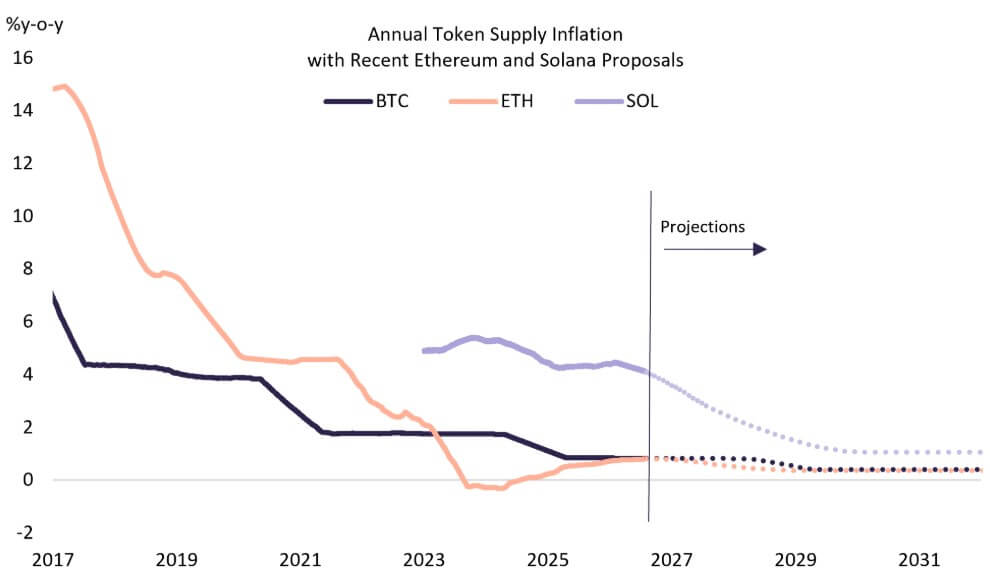
Ethereum and Solana proposed models
Solana’s SIMD-0550 would double the network’s annual disinflation rate from 15% to 30%. That reaches the 1.5% terminal inflation rate in about 2.8 years, well inside the 5.7 years the current schedule would take.
Under the proposal’s 68% staking assumption, modeled nominal yield falls from 5.84% today to 4.34% in year one, 3.00% in year two, and 2.25% in year three.
The tradeoff is 18.9 million fewer SOL entering circulation over six years, worth roughly $1.47 billion at SOL’s current price near $77.97, close to the $1.51 billion the proposal’s authors cite as their own reference figure.
Under the current schedule, an investor staking through that same three-year window would compound roughly 13.15% in simple yield, while the proposed schedule falls to about 9.89%. SOL would need roughly 3% more price appreciation over three years to make an investor whole on total return.
Ethereum’s EIP-8363, filed as a draft in early August, would burn an increasing share of validator issuance as the staking ratio climbs, with the burn reaching 100% once roughly half of ETH’s supply is staked.

One proposal author warned that continued validator entry, without reform, could push more than 70 million ETH, over 55% of supply, into staking by January 2028. The goal is to stop the network from paying ever more issuance to attract stake once enough ETH already secures the chain.
| Network | Proposal | Mechanism | Current / modeled yield | End-state target | Supply-side effect |
|---|---|---|---|---|---|
| Solana | SIMD-0550 | Doubles annual disinflation rate from 15% to 30% | 5.84% today | 2.25% by year three | 18.9M fewer SOL issued over six years |
| Ethereum | EIP-8363 | Burns a rising share of validator issuance as staking rises | Current ETH staking yield varies by conditions | 100% consensus-reward burn once ~50% of ETH supply is staked | Slows or removes validator-reward issuance as staking grows |
| Solana investor impact | Same proposal | Lower staking income | ~13.15% over three years under current schedule | ~9.89% under proposed schedule | Requires ~3% extra SOL price appreciation to offset lower yield |
| Ethereum validator impact | Same proposal | Reduces net consensus rewards | Higher reward burn as more ETH is staked | Zero net consensus issuance at upper staking threshold | Discourages excessive validator growth |
The economic argument for lower yield
Solana’s proposal frames native staking yield as something close to a risk-free rate inside its economy.
When passive staking pays 5.84%, lending, liquidity provision and other DeFi activity have to clear that bar before taking on any additional risk becomes worthwhile. Lowering that yield could redirect capital toward those other uses.
Staking still carries slashing and validator risk, a point participants in Ethereum’s debate raise to qualify how closely staking resembles a risk-free rate.
Both networks are attempting something traditional central banks rarely combine into one policy move, cutting the native rate of return while simultaneously tightening future token supply.

Investors who hold Ethereum or Solana without staking benefit most directly, since reduced issuance means less dilution reaching their share of the network. Both proposals also make Ethereum and Solana easier to market around scarcity, pulling their investment pitch a step closer to Bitcoin’s supply story.
Solana’s modeling shows the accelerated schedule pushing 2 additional validators into unprofitable territory in year one, 13 in year two, and 30 in year three, out of 738 modeled validators.
Ethereum’s debate raises sharper concerns about smaller solo validators, since large custodians and staking companies can spread fixed costs across far more ETH and often earn revenue elsewhere. That risk remains a live, unsettled argument in Ethereum’s forums.
Grayscale’s distribution framework standardizes how quickly whatever income exists reaches a brokerage account, so a shrinking pool of protocol-level rewards eventually means a shrinking pool available to distribute.
| Group | Likely impact | Why |
|---|---|---|
| Non-staking ETH/SOL holders | Benefit | Lower issuance means less dilution without giving up income they were not earning |
| Passive stakers | Lose income | The protocol-level reward pool shrinks |
| ETF shareholders | Receive smaller cash distributions | Grayscale’s framework passes staking rewards through, so lower rewards mean less income to distribute |
| Validators | Margin pressure | Smaller operators are more exposed because fixed costs are spread across less capital |
| DeFi borrowers and liquidity providers | Potential benefit | Lower staking yields reduce the hurdle rate for taking risk elsewhere |
| Token bulls | Narrative benefit | ETH and SOL become easier to frame around scarcity rather than yield |
The bull and bear case for paying less
Ethereum’s developers have acknowledged that monetary-policy changes get harder to pass as more businesses build revenue around staking yield. One participant in Ethereum’s EIP discussion specifically named staking protocols, DeFi platforms and ETFs as businesses that stand to lose from lower issuance.
Asset managers now collecting fees on staking products have a widening financial interest in how validator rewards get set, the same way bondholders care about a central bank’s rate decisions.
The bull case is that the market prices in reduced dilution faster and more durably than it prices in the lost yield, similar to how Bitcoin’s scarcity story has thrived without paying any yield at all.
ETF distributions shrink over time, and token appreciation makes up the difference in total return, and Ethereum and Solana each pick up a cleaner scarcity narrative on top of proof-of-stake’s existing utility.
The bear case has staking investors treating lower rewards as what they look like: a pay cut, as cash and short-term Treasuries keep offering competitive yield with less risk attached.
| Scenario | What investors focus on | ETF distribution impact | Validator impact | Price implication |
|---|---|---|---|---|
| Bull case | Lower dilution and stronger scarcity narrative | Distributions fall, but token appreciation offsets lost income | Network remains secure despite lower rewards | ETH/SOL re-rate higher as scarcer assets |
| Base case | Mixed total-return tradeoff | Distributions gradually shrink | Smaller validators face pressure, but no major exit shock | Prices need stronger demand to offset lower yield |
| Bear case | Staking reward cuts look like a pay cut | ETF income pitch weakens | Marginal validators and solo stakers retreat first | Scarcity premium fails to offset income loss |
| Political-economy risk | Businesses defend staking revenue | Asset managers and staking protocols resist cuts | Governance debates slow implementation | Proposals get diluted, delayed, or rejected |
ETF products lose part of their pitch, validators with thin margins retreat first, and the scarcity premium the protocols are counting on never grows large enough to offset the income given up.
Ethereum and Solana are betting on scarcity over yield. That bet depends on something that a protocol upgrade cannot control: how much investors decide scarcity alone is worth.
Credit: Source link