
Fed guarantees 2-day stablecoin payouts, but $76B remains blocked
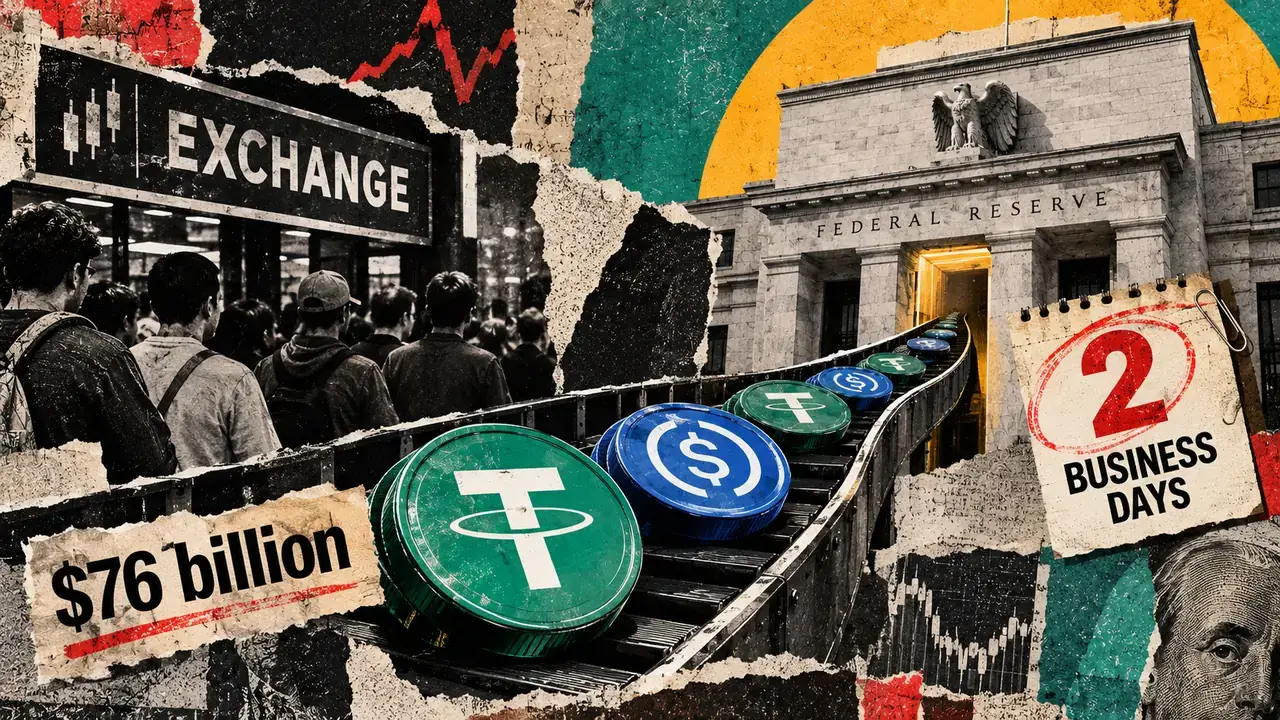
The Federal Reserve’s stablecoin proposal would put a general two-business-day limit on redemption by issuers it supervises.
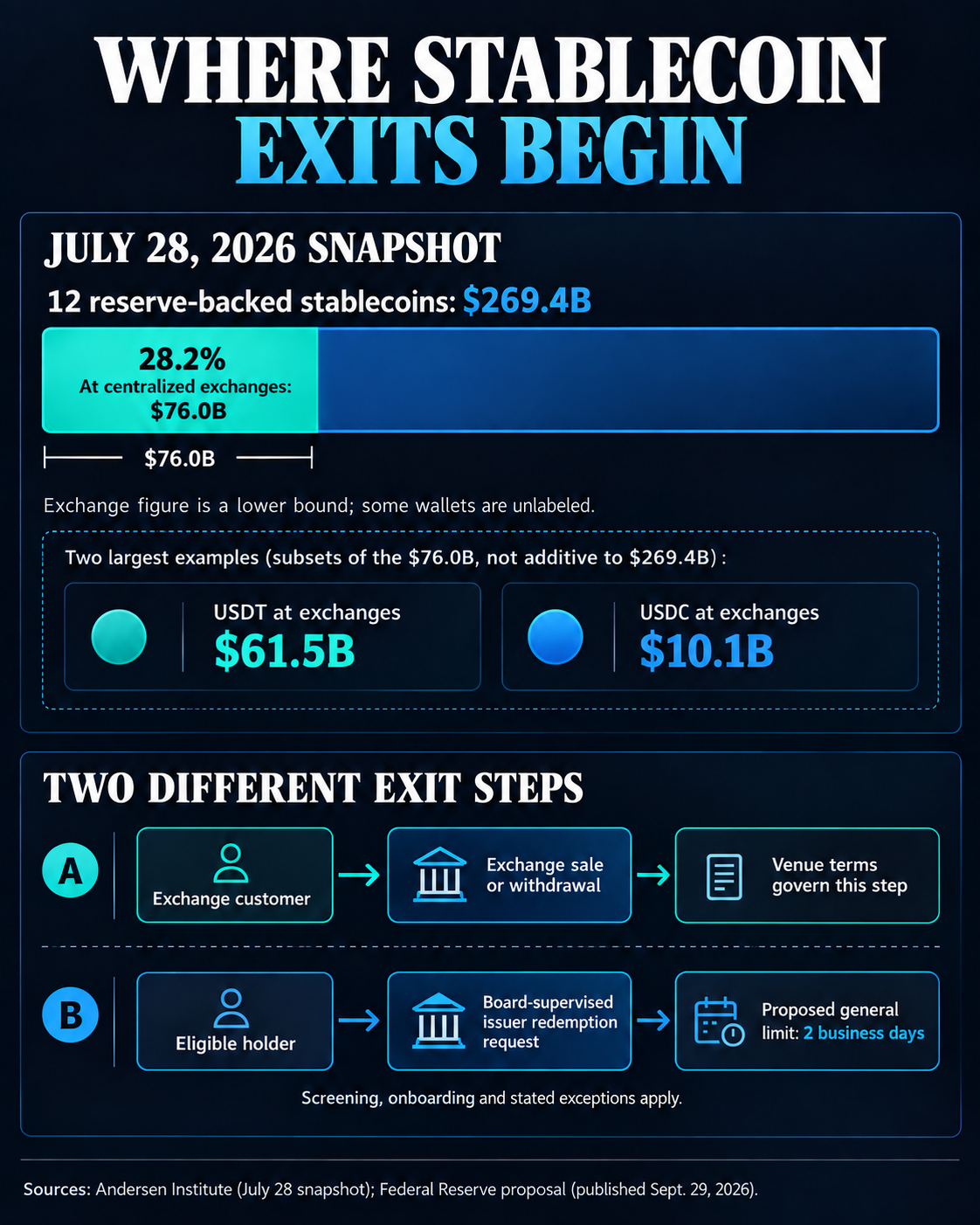
For a customer holding stablecoins at an exchange, the first step is getting that venue to release or convert the balance. In a July 28 snapshot, researchers located $76 billion of stablecoins at centralized exchanges, where a customer may have to deal with the venue before reaching an issuer.
Researchers at the Andersen Institute for Finance and Economics located that amount across 12 reserve-backed dollar stablecoins. They call the exchange figure a lower bound because some exchange wallets cannot be identified.
Where the proposed clock starts
The Fed proposal, published in the Federal Register on Sept. 29 after the Board announced it on Sept. 24, would require a Board-supervised payment stablecoin issuer to disclose its redemption procedure.
Under proposed section 247.12, its normal period to redeem after a request could not exceed two business days. The issuer would have to explain how a customer can redeem and accept requests for at least one token, subject to screening and onboarding.
The Board could extend the period for safety, financial stability or the public interest. The proposal also includes limited safe harbors for delays tied to required customer checks or circumstances outside an issuer’s control. The requirements remain under public comment.
If an exchange makes a qualifying redemption request to an issuer, that issuer’s obligations could matter to the exchange. An exchange customer’s instruction to sell, convert or withdraw a balance is a separate transaction with the venue. The venue’s terms govern that customer-facing step.
Current terms show why the distinction matters. Circle says direct USDC redemption under its terms for holders outside the European Economic Area is available to an eligible holder with a Circle Mint account in good standing.
A holder without that account cannot redeem directly with Circle until eligible and registered, as the firm describes Mint as a service for institutional distributors.
Coinbase’s US agreement says a customer owns the balance of a USDC wallet, but Coinbase is not obliged to repurchase USDC for dollars. It may choose to do so, and the agreement points customers to Circle for direct redemption under Circle’s separate terms.
Coinbase also reserves the right to suspend sending or trading, while Circle Mint eligibility and the timing of a specific exchange withdrawal depend on the customer’s circumstances and venue.
The Andersen snapshot itself also has a scope problem for anyone trying to apply the Fed proposal to the full $76 billion. It includes $61.5 billion of USDT and $10.1 billion of USDC at exchanges, plus other coins, while the Fed text addresses Board-supervised issuers.
Tether’s current terms require a verified customer for direct redemption and post a $100,000 minimum. The venue total combines distinct issuer policies and regulatory categories, requiring issuer-by-issuer analysis before comparing it with the proposal’s scope.
What one stablecoin run can show
The Andersen researchers also traced venue balances during the March 2023 USDC stress episode. Using March 9 as the pre-shock baseline for that episode, they found that exchanges held 15.2% of USDC supply but accounted for 40% of the subsequent supply decline.
The data compare token balances at identified exchange wallets with overall supply, while individual customer redemption routes lie outside these wallet-balance measurements. The exchange-held portion moved sharply in this one historical stress period.
From March 10 to 13, USDC supply fell $2.7 billion while identified exchange balances rose $600 million. After March 13, supply fell another $8.1 billion and exchange balances fell $4.9 billion. In the first phase, tokens moving onto exchanges could coexist with a shrinking overall supply, while the larger exchange-balance decline came later.
Treating the whole episode as an immediate exchange exodus would miss that reversal.
That 2023 USDC episode offers limited guidance about how USDT or the other coins might behave under a future shock. Wallet-location data also leave the order of individual exchange requests unknown.
The proposed rule would define redemption obligations for issuers within the Board’s remit, with exceptions and eligibility checks. Andersen’s July snapshot identifies the scale of balances held at exchanges. Today’s venue balances and customer exit times require fresh, separate evidence.
Credit: Source link