
Coinbase just completed its US derivatives stack but its biggest bet still sits outside it
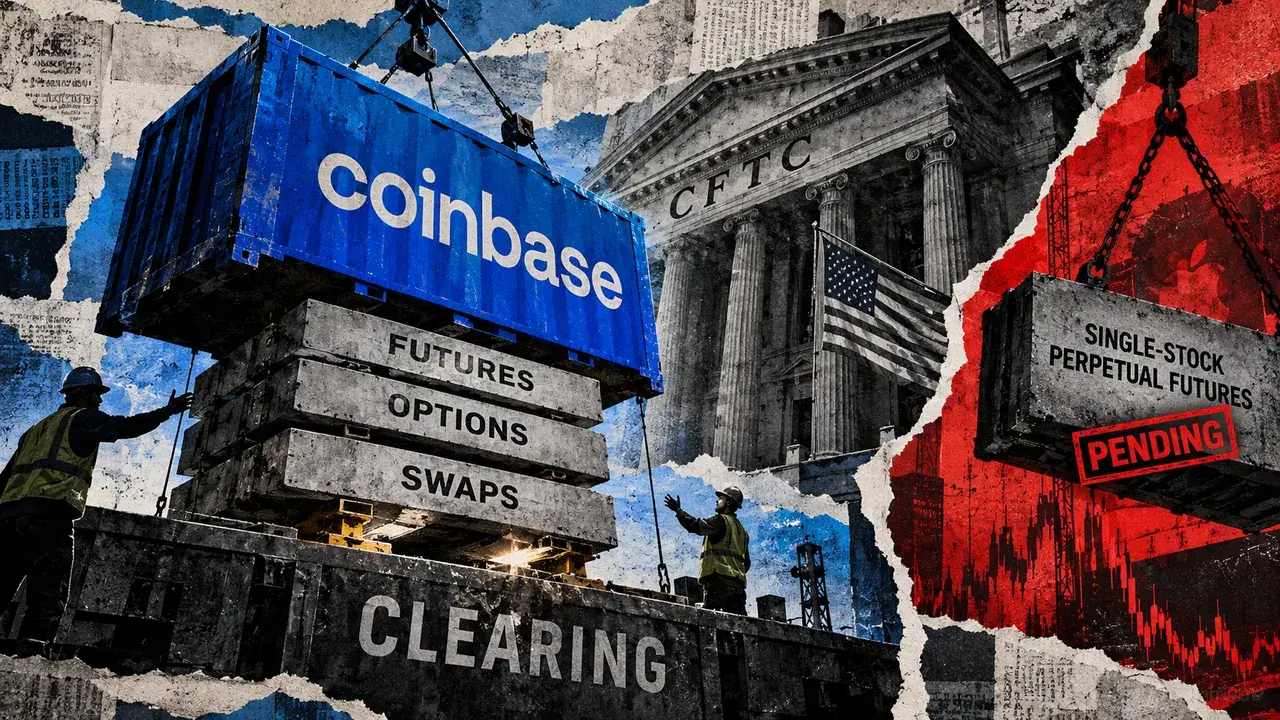
Coinbase, the largest US-based crypto exchange, has secured Commodity Futures Trading Commission (CFTC) approval for its own derivatives clearinghouse, completing a vertically integrated US trading stack.
On Sept. 28, the CFTC registered Coinbase Clearing LLC as a derivatives clearing organization, authorizing it to clear fully collateralized futures, options on futures, and swaps. The approval gives Coinbase control over a function that has previously depended on outside clearing partners.
Coinbase now operates across the three main layers of the regulated US derivatives market: Coinbase Financial Markets as a futures commission merchant, Coinbase Derivatives as a designated contract market and Coinbase Clearing as a registered clearinghouse. The company said the structure gives it end-to-end infrastructure for bringing regulated products to market.
The immediate scope is narrower than the full derivatives business Coinbase is building. The new clearinghouse can directly create and settle fully collateralized contracts, with Coinbase pitching USDC collateral and 24-hour settlement as advantages for products designed around always-on markets.
Owning that infrastructure could shorten product-development cycles and reduce reliance on third parties for eligible contracts. The firm said it expects the clearinghouse to support more efficient operations and give it greater flexibility to introduce regulated derivatives over time.
Stock perps remain outside Coinbase’s new clearinghouse
However, one of Coinbase’s most ambitious planned products will initially remain outside that integrated structure.
The company said it will continue using existing partners for parts of its margined derivatives business and for its planned single-stock perpetual futures. Those contracts remain under separate regulatory review even after the clearinghouse approval.
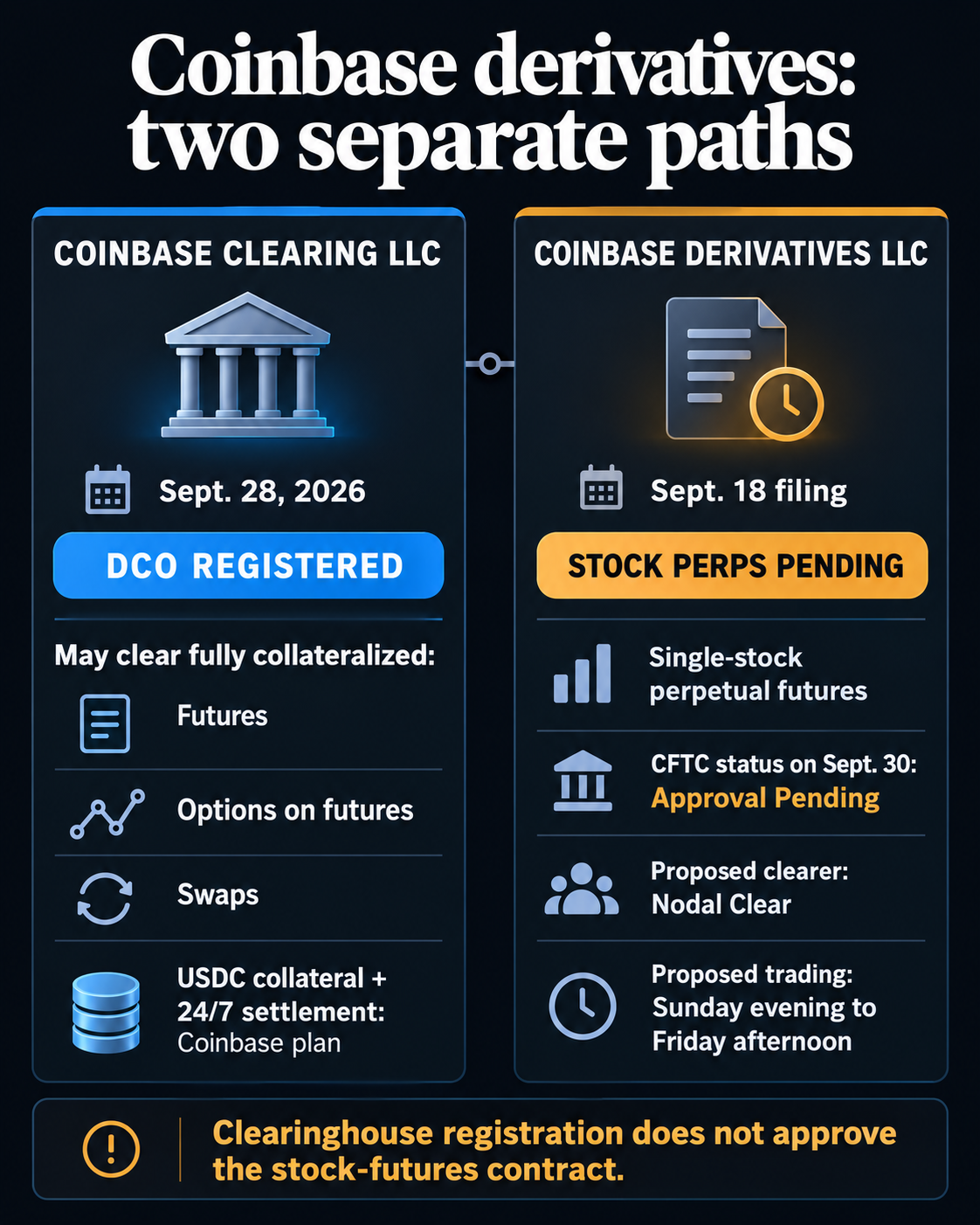
The CFTC’s product record for Coinbase Derivatives continued to show its Single Stock Perpetual Futures Contract as “Approval Pending” on Sept. 30. The exchange filed the proposal on Sept. 18 and said it intended to begin listing the contracts shortly after approval, subject to any additional regulatory requirements
The filing proposes cash-settled perpetual futures tied to individual US equities and exchange-traded funds, with Apple serving as the representative contract. Unlike conventional futures, the contracts have no fixed expiration and use periodic funding payments to keep their prices aligned with the underlying shares.
That representative Apple contract names Nodal Clear LLC, rather than Coinbase Clearing, as the central counterparty. Its proposed trading window runs from 8 p.m. Eastern on Sunday through 5 p.m. Friday, while Coinbase describes its new clearing infrastructure as capable of 24/7 settlement.
The split gives the US-based crypto trading platform more control over fully collateralized derivatives while retaining external infrastructure for products that require a different clearing arrangement.
What moves onto Coinbase Clearing next will determine how quickly that changes. The company can now develop products around its own USDC-based clearing system, while approval of the stock perpetuals would open a separate expansion into equity-linked derivatives.
For now, the next regulatory milestone sits with the stock-perpetual filing. If approved, Coinbase will gain the product it has positioned as a major extension of its derivatives business, even as the contracts begin life on infrastructure the company does not fully control.
Credit: Source link