
Trump-Linked WLFI Crashes as Binance Shuts Winning Shorts

- WLFI lost nearly half its value in one session and set a record low.
- Binance closed WLFI futures positions on both sides, and World Liberty denies any role.
- The USD1 stablecoin briefly lost its dollar peg on Binance during the sell-off.
- Justin Sun urged exchanges and regulators to act against WLFI and USD1.
World Liberty Financial’s WLFI token fell 45.10% to $0.0196 on Saturday, November 28, after touching a low of $0.0158. During the drop, Binance forcibly closed positions on both sides of its WLFI perpetual futures market. The Trump family-linked project says it had no role in those closures. Its USD1 stablecoin also briefly slipped to $0.94 on Binance, and TRON founder Justin Sun, an early WLFI investor who is now suing the project, called on exchanges to delist both tokens.
World Liberty pins the closures on Binance
Earlier on Saturday, Binance switched its WLFIUSDT perpetual contract to reduce-only mode. An in-app notice said the pair was under position risk control, so traders could shrink or exit positions they already held but could not open new longs or shorts. Later that day, World Liberty Financial said on its official X account that Binance had automatically closed positions on both sides of the market. It added that some users saw a gap between the unrealized profit their accounts showed and what they actually received at settlement.
The project said Binance runs its own derivatives market, including the auto-deleveraging system, and that WLFI played no part in managing or settling the affected trades. It told those traders to contact Binance support and said it is investigating.
WLFI RSI sinks to 11
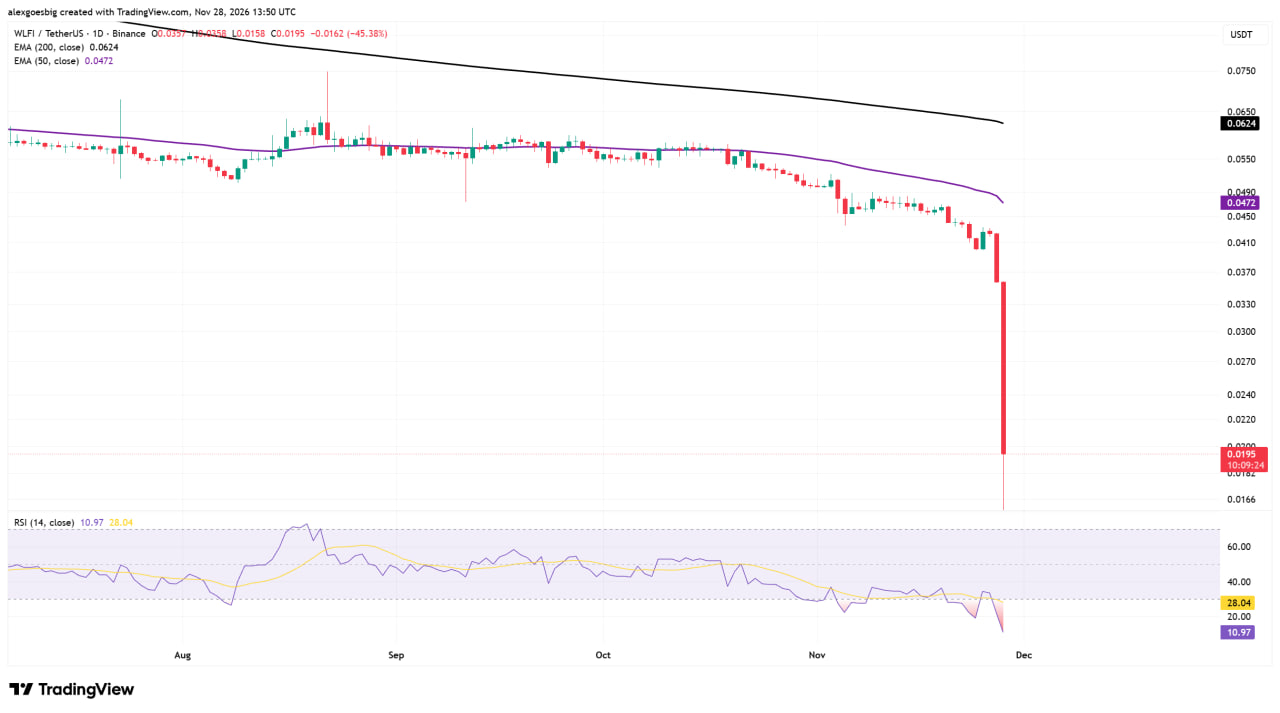
On the daily chart, weeks of lower highs and lower lows turned into a steep drop once WLFI lost its $0.045 to $0.048 range. The token now trades about 58.5% below its 50-day exponential moving average (EMA) of $0.0472 and 68.6% below its 200-day EMA of $0.0624. Both averages are still sloping down.
The daily Relative Strength Index has fallen to 11, far below the oversold line of 30 and its own signal average of 28.04. A reading that low means selling has run well ahead of buying, and such readings often come before a short bounce. It does not mark a bottom on its own, especially for a project under this much pressure. The daily candle is still open, so the close and the RSI reading could change before midnight UTC.
| Level | Price | Why it matters |
|---|---|---|
| ▲ Resistance | $0.035 – $0.036 | Where Saturday’s candle opened |
| ▲ Resistance | $0.030 | First sign sellers are easing |
| ● Pivot | $0.020 | Round number just above the price |
| ▼ Support | $0.0158 | Saturday low, with no price history beneath it |
Until WLFI sets a higher low, any rebound from these levels looks like a relief bounce within a downtrend.
Why profitable shorts were cut first
Auto-deleveraging, or ADL, is what Binance falls back on when a liquidated trader’s losses are bigger than their margin. Binance describes it as the final step in its liquidation process. It kicks in only when the exchange’s futures insurance fund cannot take over a bankrupt position. In a sell-off as fast as Saturday’s, leveraged longs can blow through their margin before the order book can absorb them. The exchange then has to close those losses against traders on the other side, and several short sellers said on social media that their WLFI positions had been reduced or closed automatically.
Binance ranks those traders by profit and effective leverage, so highly leveraged winning shorts are first in line. The forced closure can be settled at the bankrupt trader’s bankruptcy price rather than the current market price. Binance’s documentation admits this price can fall outside the range the contract actually traded in. A trader who saw a large paper gain on screen can therefore walk away with much less. Binance does offer an ADL protection program, but it covers selected Bitcoin, Ethereum and BNB contracts, and WLFI is not on the published list. Neither company has confirmed that ADL caused every closure reported on Saturday.
USD1 stablecoin slipped to 94 cents on Binance
World Liberty’s dollar-pegged token got caught in the same sell-off. On Binance, USD1 touched $0.9400 against USDT and $0.9389 against USDC before buyers pulled it back toward $0.99. The discount was almost the same on both pairs, so the selling hit USD1 itself and was not caused by a quirk in Tether’s price. A short dip like this on one exchange shows panic and thin liquidity, but on its own it does not prove that USD1’s reserves are short.
Reserve wallet sold ETH at a 49% loss
On-chain analyst EmberCN tracked a wallet tied to World Liberty’s strategic reserve that sold about 12,121 ETH shortly before the futures disruption. The sale brought in roughly $20.06 million in USDC and USD1. EmberCN puts the average sale price at $1,655, compared with a purchase cost of $3,244, which means a realized loss of about $19.26 million. So far, nothing links those sales to Binance’s forced closures.
The project’s April 2026 loan on Dolomite, a decentralized lending protocol co-founded by World Liberty adviser Corey Caplan, is drawing closer attention. World Liberty posted five billion WLFI as collateral to borrow around $75 million, and by mid-April it had repaid $25 million, leaving $50 million outstanding. At Saturday’s low of $0.0158, that collateral was worth about $79 million, a much thinner cushion than the roughly $440 million it was valued at when the loan was taken. The current balance and the loan’s liquidation threshold have not been disclosed since then.
| Asset | Before | Saturday |
|---|---|---|
| WLFI price | $0.0357 open | ↘ $0.0158 low |
| Dolomite collateral | ~$178.5M at open | ↘ ~$79M vs $50M owed |
| Reserve ETH | Bought at $3,244 | ↘ Sold at $1,655 |
| USD1 peg | $1.00 | ↘ $0.94 |
Sources: Binance, EmberCN
Sun wants WLFI and USD1 off exchanges
In his lawsuit, Sun says he invested $45 million in World Liberty between November 2024 and January 2025. In a post on X, he called Saturday’s episode a repeat of “insider circular lending to cash out.” He accused the team of unauthorized insider selling, illegally freezing investor assets and fraud. He asked exchanges, regulators and courts to issue warning lists, delist WLFI and USD1, and restrict deposits. No court has ruled on any of these claims.
Today’s WLFI episode is just another rerun of insider circular lending to cash out, unauthorized insider selling, the illegal freezing of investor assets, and investor fraud. I call on major exchanges, regulators, judicial authorities, and the courts to take prompt action against…
— H.E. Justin Sun 👨🚀 🌞 (@justinsuntron) November 28, 2026
The feud began when World Liberty blacklisted one of Sun’s wallets in September 2025. Sun sued in April 2026, and World Liberty answered with a defamation countersuit in May. Over the summer, HTX, where Sun sits on the global advisory board, removed USD1 trading.
WLFI futures stay locked on Binance
For now, no one can open a new long or short on Binance’s WLFIUSDT contract. That shuts one of the deepest markets for hedging WLFI exposure until Binance lifts the restriction. Traders who think they were closed out at unfair prices have to take it up with Binance directly. The contract is not covered by the ADL guarantee, and World Liberty denies any role in settlement.
On-chain, the Dolomite loan is the position to watch, because every further drop in WLFI shrinks the collateral behind it in real time. World Liberty has promised more findings on the futures closures. Together with any explanation from Binance of how the WLFIUSDT positions were priced at settlement, that update will show whether affected traders have a case for compensation.
Credit: Source link