
A New Bull Run? Bitcoin Investors Have Stopped Selling, And Demand Is Rising

Bitcoin flows into exchanges have dropped to levels not seen in over six years, and this could be the first of many signs of a bull run. The latest on-chain data shows a massive drop in the amount of BTC being moved onto trading platforms, hinting at a slowdown in selling activity even as uncertainty continues to hang over the crypto industry.
Exchange Inflows Collapse To Multi-Year Lows
According to analysis shared by CryptoQuant author Darkfost, Bitcoin inflows into Binance have fallen to levels last observed in 2020. The 30-day moving average of Bitcoin flowing into Binance is now around 3,998 BTC. This stands in stark contrast to earlier periods of activity, during both bear and bull markets.
When investors are afraid, they sell. They move their Bitcoin onto exchanges, where liquidation is fast and easy. To put this into context, that is what happened in July 2023, when daily inflows to Binance were around 19,000 BTC on average, and again during the May 2021 bull market peak, when daily inflows surpassed 25,000 BTC.
This analysis is based on the Binance BTC inflows 30DMA, which tells the story clearly. The chart shows that inflow activity that peaked somewhere around July 2021 and has since collapsed to its leftmost edge, where the current reading is around 3,900 BTC.
For further reference, the historical average of Bitcoin inflows into Binance is 11,000 BTC, which means the figures show a market operating below its usual pace and current inflow levels are roughly three times below normal.
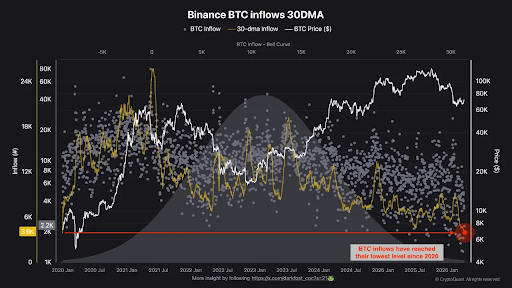
Binance BTC Inflows 30DMA. Source: CryptoQuant
Institutions Are Filling The Gap
The absence of selling does not mean indifference. It reflects, according to Darkfost, a holding strategy, which mechanically reduces short-term selling pressure, one that has persisted through a market that has given investors plenty of reasons to reconsider.
Bitcoin peaked at $126,080 in October 2025 before entering a correction path that pushed the price to as low as $60,000 in February 2026. The recovery back to $75,000 in recent days has been gradual and uneven. However, through all of it, for several consecutive months, Bitcoin inflows to Binance have remained well below the historical norm.
There is also a secondary dynamic at play, and part of the missing exchange activity can be traced to the rise of spot Bitcoin ETFs. A growing share of Bitcoin activity now flows through ETFs, reducing the visible BTC movement that analysts track on platforms like Binance.
US Spot Bitcoin ETFs have logged back-to-back days of significant inflows this week. On April 14, the ETFs recorded $411.5 million in net inflows, with BlackRock’s iShares Bitcoin Trust leading the charge at $214 million. Momentum continued on April 15 with another $186 million in net inflows. The result is a setup where selling pressure is reduced as fewer coins are sent to exchanges, while demand is increasing through ETF channels.
Featured image created with Dall.E, chart from Tradingview.com

Editorial Process for bitcoinist is centered on delivering thoroughly researched, accurate, and unbiased content. We uphold strict sourcing standards, and each page undergoes diligent review by our team of top technology experts and seasoned editors. This process ensures the integrity, relevance, and value of our content for our readers.
Credit: Source link