
Polymarket built a $14 billion US trading business almost entirely on sports bets
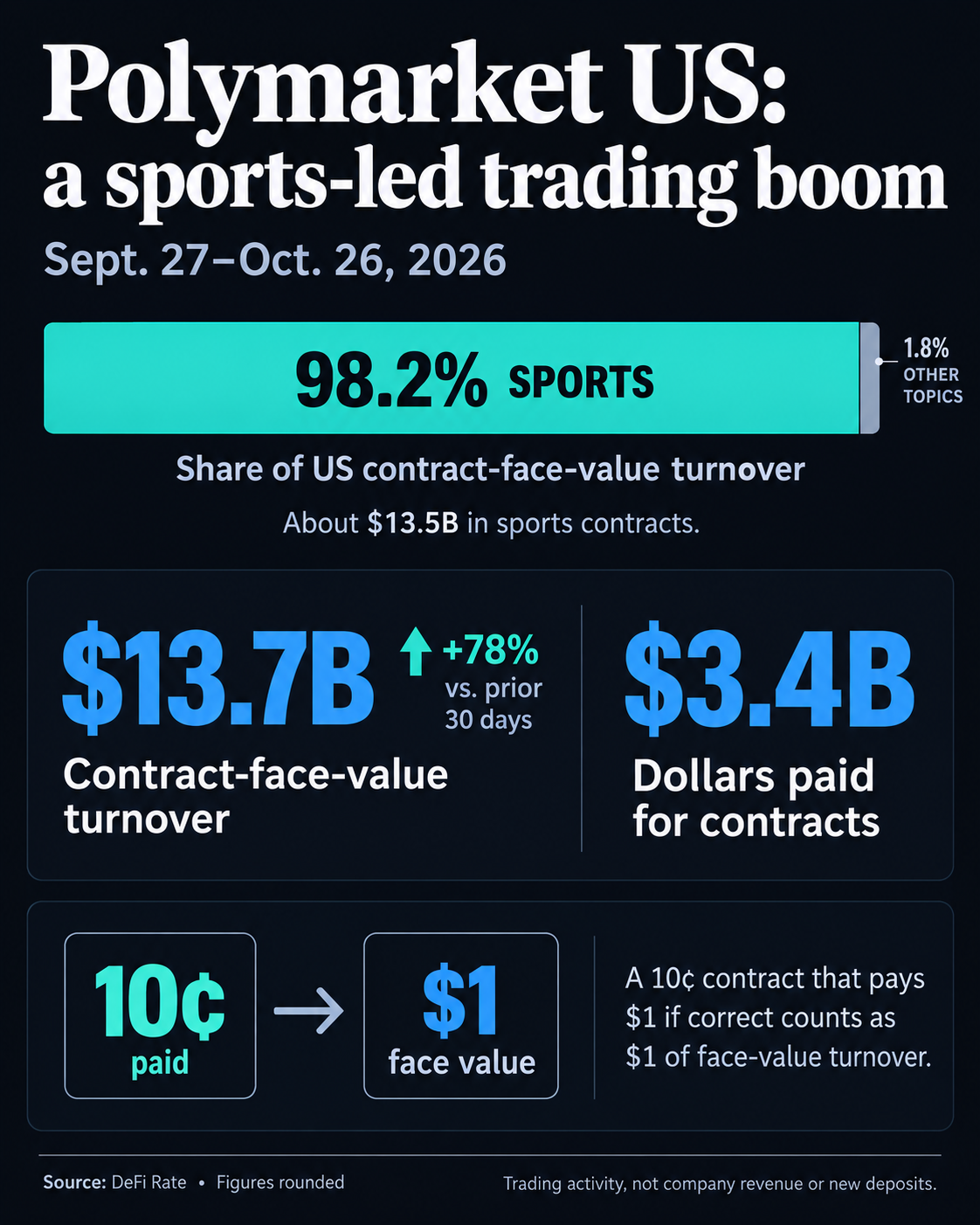
Polymarket’s US prediction exchange recorded about $13.7 billion in contract-face-value trading in the 30 days through Oct. 26, with sports accounting for 98.2% of that turnover, according to DeFi Rate’s data.
That concentration leaves its American expansion heavily exposed to the dispute over whether sports event contracts fall under federal derivatives oversight or state gambling laws.
The figures coincide with Reuters’ Oct. 27 report that the Commodity Futures Trading Commission (CFTC) is again examining compliance with Polymarket’s 2022 settlement restricting US access to its offshore platform.
The report also examined onboarding and customer protections at the newer US exchange, citing two people familiar with the matter.
Alongside these questions sits a broader fight over who regulates prediction markets, as the CFTC announced Oct. 27 that it had sued Utah, adding to proceedings against nine other states.
Two measures of Polymarket’s expansion
In a measurement from Sept. 27 to Oct. 26, DeFi Rate puts Polymarket US’s face-value turnover up 78% from the preceding 30 days, with sports supplying about $13.5 billion of the latest total.
The dataset counts each contract at its $1 face value, regardless of its purchase price. A contract bought for 10 cents that pays $1 if correct contributes $1 to headline volume and 10 cents to dollars paid.
Face-value turnover measures something different from trading volume, and both are measures of trading activity.
The matching venue comparison shows how the choice of measurement changes the balance between Polymarket’s two businesses:
| Sept. 27-Oct. 26, 2026 | Contract-face-value turnover | Dollars paid |
|---|---|---|
| Polymarket US | $13.7 billion | $3.4 billion |
| Polymarket international | $4.8 billion | $2.4 billion |
| US share of the two venues combined | About 74% | About 59% |
The US venue leads by both measures, but its dominance is less pronounced when contracts are weighted by the prices traders actually paid.
Polymarket describes separate US and international platforms and says US users are prohibited from trading on the international operation. The offshore-access inquiry concerns compliance with restrictions on that separate international operation.
Reuters reported that the renewed inquiry includes controls to determine customers’ locations and to advertise in the US, with one source describing scrutiny of past controls and processes.
The historical starting point is the CFTC’s Jan. 3, 2022 settlement, which required a $1.4 million penalty, the wind-down of noncompliant markets and an end to the charged violations.
In July 2025, the CFTC closed earlier probes, and broader scrutiny began in June 2026.
Sports growth meets the state-law fight
The CFTC’s Utah announcement asserts exclusive federal jurisdiction over registered prediction markets. Utah’s attorney general alleged that Kalshi’s sports and other event contracts violate state gambling laws and seeks to stop those offerings in Utah.
Utah’s enforcement case targets Kalshi, and its significance for Polymarket depends on how courts resolve the federal-state jurisdictional dispute.
The NBA named Polymarket and Kalshi as preferred prediction market exchanges on Oct. 26. Separately, the CFTC and NBA announced an information-sharing memorandum focused on integrity in basketball prediction markets.
For Polymarket US, business exposure depends on its trading mix. Broad sports-contract restrictions could affect most of the recent face-value turnover if that mix persists. Narrower restrictions would depend on the specific contracts and jurisdictions covered.
Next developments to watch include any enforcement outcome from the reported inquiry, changes to geographic access or onboarding controls, and court decisions defining the reach of state gambling laws.
The next comparable trading window will also show whether non-sports activity becomes a larger part of the US business. Its recent measured turnover is overwhelmingly sports-based, leaving its ability to sustain that activity exposed to the terms under which those contracts remain available.
Credit: Source link