
Revolut hit by Washington crypto boom illusion, exposing massive two-tier banking system
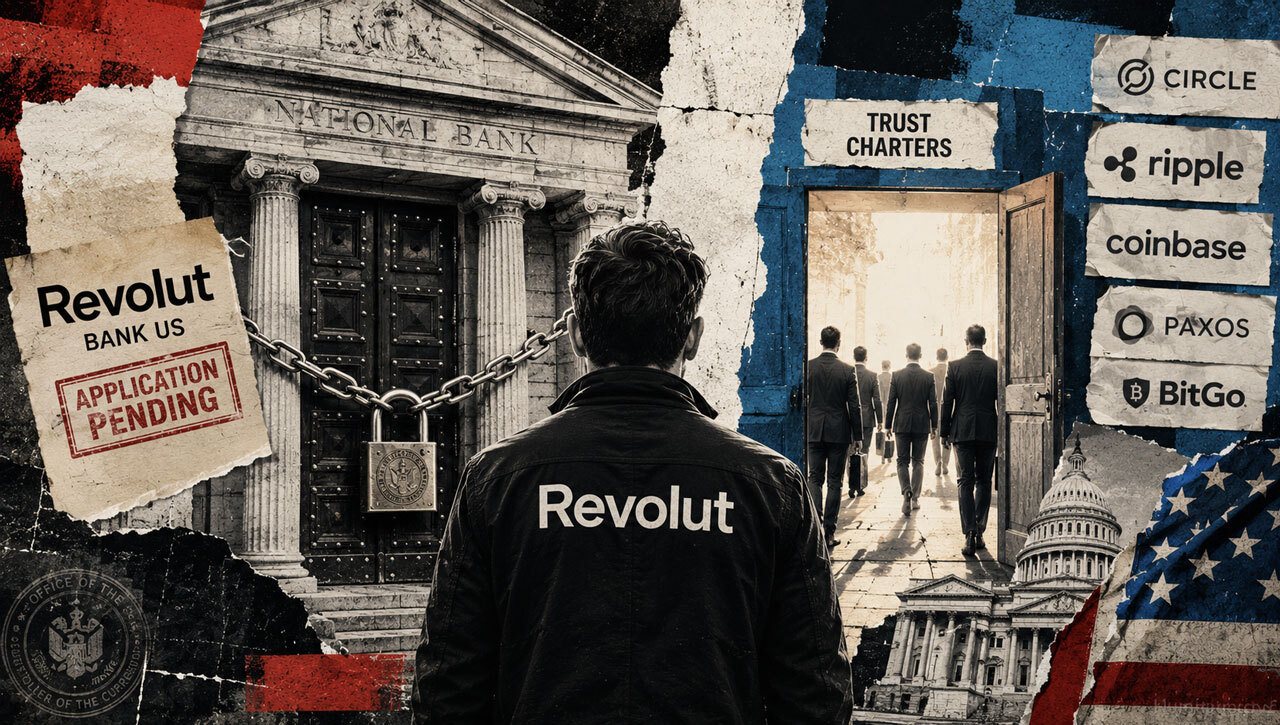
Revolut filed with the OCC and FDIC on March 4 to establish Revolut Bank US, an insured national bank that would take deposits, issue credit cards, make loans, and connect directly to Fedwire and ACH.
Nearly six months later, that application remains pending, while federal regulators have spent the same stretch conditionally approving or converting bank charters for Circle, Ripple, Coinbase, Paxos, BitGo and several other crypto firms.
Revolut has not been denied, though its application sits under review, and comparing it directly to those crypto approvals misses what each company asked Washington for.
A national bank wants more
Revolut’s application describes a full-service digital national bank supporting deposit accounts, card products, consumer and commercial lending, cross-border payments, and investment and trading services, built to reduce the company’s reliance on partner banks.
The company says it serves more than 70 million customers across 40 markets and carries a $75 billion valuation, reached in a November 2025 secondary offering.
That puts the application through every layer of traditional bank review at once. Regulators must weigh capital and liquidity adequate to survive stress, credit underwriting and loss reserves for its lending book, and BSA and OFAC compliance given the deposits and payments involved.
Community Reinvestment Act obligations tied to insured status add another layer, along with an OCC judgment on whether Revolut’s management can run a US national bank safely. Federal deposit insurance adds exposure to the Deposit Insurance Fund itself, an industry-funded, government-backed layer none of the crypto trust charters carry.
| Feature | Revolut’s requested national bank | Most crypto trust charters |
|---|---|---|
| FDIC-insured deposits | Yes | No |
| Credit cards / personal loans | Yes | Generally no |
| Consumer and commercial lending | Yes | Generally no |
| Fedwire / ACH access | Yes, sought directly | Not the central purpose |
| Digital-asset custody | Possible | Core activity |
| Stablecoin reserves / issuance | Not the main request | Often central |
| CRA obligations | Yes | Often no if not insured |
| Deposit Insurance Fund exposure | Yes | No ordinary insured-deposit exposure |
| Main regulatory question | Can Revolut run a safe national bank? | Can crypto firms safely custody assets or manage reserves? |
Most crypto approvals cover something narrower than Revolut’s case
The OCC’s December 2025 approvals for First National Digital Currency Bank and Ripple National Trust Bank, along with conversions for BitGo Bank, Fidelity Digital Assets Trust Company and Paxos National Trust, were national trust-bank approvals.
They centered on custody, reserves, and digital-asset services, well short of full deposit banking.
Circle’s charter provides custody for the firm, its affiliates, and a limited set of institutional customers. Coinbase National Trust Company offers digital-asset custody and related transactional services strictly to custody clients.
World Liberty’s trust bank issues and redeems its USD1 stablecoin and holds reserves. Its OCC decision states plainly that the company has no plans to become an insured depository institution, so Community Reinvestment Act requirements do not apply.
Bridge, owned by Stripe, received a similar stablecoin-and-custody trust charter, with the OCC noting that the stablecoins involved are not deposits and carry no FDIC insurance under the GENIUS Act framework.
Still, these are not the same license Revolut is seeking, but the gap between them is worth reading into.
The comparison that runs through other fintechs
Three other companies pursued the same full-service insured bank charter Revolut wants, and their outcomes show what the OCC requires.
Nubank received preliminary conditional approval in January for a new national bank offering lending, deposits, and digital-asset custody. The OCC noted it still needs FDIC insurance and other preopening approvals before final sign-off.
Upstart received similar preliminary conditional approval in July for a fully digital insured lender focused on consumer credit, while bunq did not clear that bar.
The OCC denied bunq’s application over issues with capital, management experience, profitability assumptions, and risk to the Deposit Insurance Fund. The agency found that bunq’s proposed leadership lacked sufficient US banking and credit-product experience and that its financial projections were not adequately supported.
Revolut sits inside that same full-bank lane, which makes Nubank, Upstart and bunq the honest comparison set, well beyond Circle or Coinbase.
| Applicant | What it sought | OCC status | What it shows |
|---|---|---|---|
| Nubank | Full-service insured national bank with deposits, lending, and digital services | Preliminary conditional approval | The full-bank path is open, but conditional |
| Upstart | Digital insured bank focused on consumer credit | Preliminary conditional approval | Lending-heavy fintechs can advance with conditions |
| bunq | Full-service national bank | Denied | Capital, management, profitability, and DIF risk can stop an application |
| Revolut | Full-service insured national bank with deposits, cards, loans, and payment rails | Pending | The OCC is still testing whether Revolut clears the full-bank bar |
The Revolut review has turned contested on its own terms
Fair Finance Watch filed formal opposition to Revolut’s application on May 7, citing the company’s international compliance history and criticizing its Community Reinvestment Act plan.
The Federal Reserve has since pressed Revolut on BSA and OFAC obligations, the timeframe behind its CRA plan, and its planned service to low- and moderate-income communities.
Lithuania’s central bank fined Revolut €3.5 million in 2025 for anti-money laundering deficiencies found during a routine inspection, covering gaps in transaction monitoring and suspicious-activity detection.
Regulators identified no confirmed money laundering, and Revolut says it has committed to corrective action.
Inner City Press has separately alleged that the OCC withheld more than 1,000 pages of records tied to the Revolut review in response to a FOIA request.
That claim shows the review has become genuinely adversarial at the same moment the OCC is publicly marketing itself as newly open to chartering.
Comptroller Jonathan Gould said in August that the OCC had received 40 new charter applications since President Trump took office, with 23 involving digital assets.
The agency had resolved many complete applications within roughly 120 days, a timeline applied only to complete filings.
The OCC’s guidance allows it to return deficient filings or request additional information when supervisory, compliance, or CRA issues remain open. A faster chartering posture and a cautious approach to insured deposit-taking can coexist inside the same agency without contradiction.
The length of the full-bank lane
The bull case has Revolut eventually joining Nubank and Upstart with conditional approval, showing that a global fintech can become a US national bank if it fully satisfies capital, CRA, management, and compliance requirements.
Under that path, more competition arrives in deposits, cards, remittances, and crypto-linked retail finance, and the broader “crypto banking boom” narrative gains a genuine full-bank chapter alongside its custody and stablecoin one.
The bear case has Revolut’s review dragging on, facing a bunq-style denial, or ending in withdrawal, while trust-bank approvals for crypto firms keep moving forward on their own separate track.
| Scenario | Revolut outcome | What it means for crypto banking |
|---|---|---|
| Bull case | Revolut receives conditional approval | The OCC is willing to let large fintechs move beyond custody and stablecoins into full banking |
| Base case | Review continues with more conditions and information requests | Trust charters keep moving faster than insured bank charters |
| Bear case | Revolut withdraws or faces a bunq-style denial | The crypto banking boom remains mostly a custody and stablecoin infrastructure story |
| Policy signal | OCC remains open to digital assets but cautious on deposits and lending | Federal banking access is expanding, but not all charters carry the same powers |
In that scenario, the apparent boom in crypto banking narrows considerably in practice. Custody and stablecoin infrastructure keep advancing under federal supervision, while the harder door into deposit-funded, FDIC-insured banking stays about as difficult to walk through as it always was.
Washington has genuinely opened federal banking infrastructure to digital assets this year. It has not yet decided how far it will open the older, harder door sitting right next to it, and Revolut’s application is where that answer is getting tested.
Credit: Source link