
SEC and CFTC plans to write crypto rules without Congress
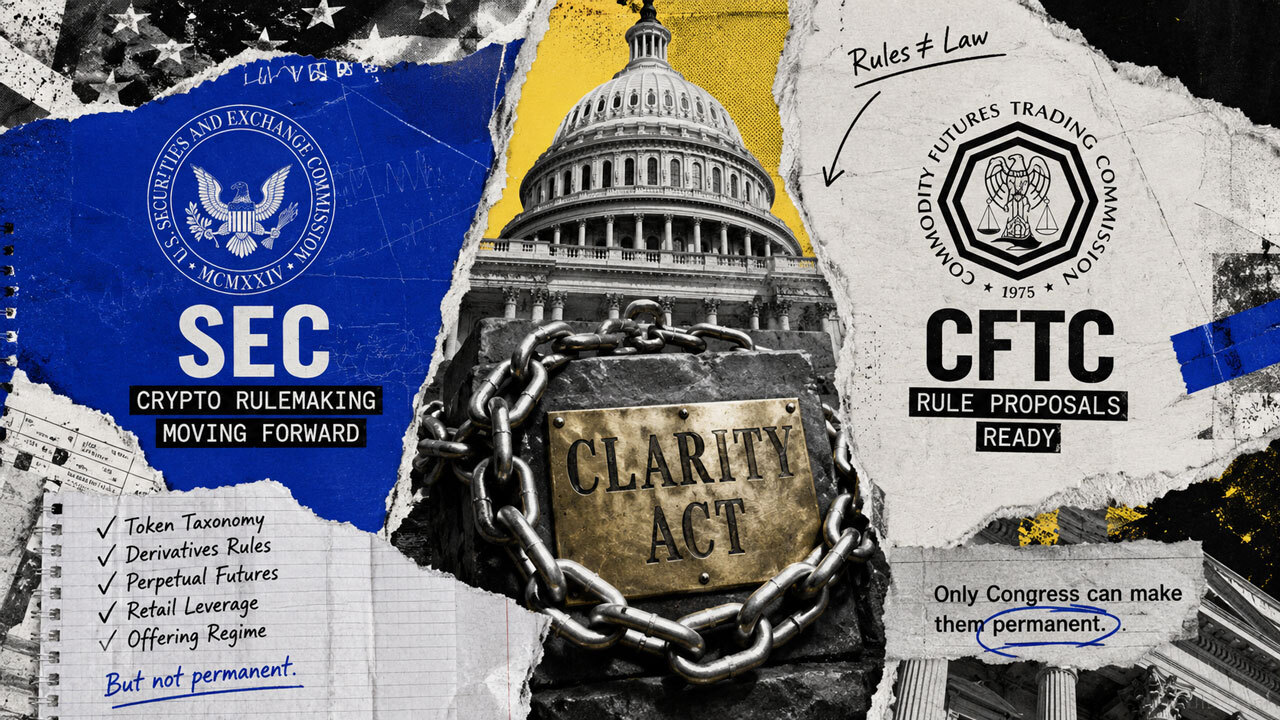
CFTC Chair Michael Selig said on Aug. 4 that the agency has crypto rule proposals ready and plans to finalize them before the current administration ends, regardless of whether Congress passes the CLARITY Act.
SEC Commissioner Hester Peirce has separately said the SEC can keep pursuing meaningful crypto rulemaking even if Congress fails to act.
The Senate left CLARITY untouched before its August recess, and Majority Leader John Thune has filed cloture on a motion to proceed, setting up a procedural vote around Sept. 15 that would require 60 votes to advance the bill.
The House already passed its own version of CLARITY, 294-134, last July.
| Track | What is happening | Timeline | Why it matters |
|---|---|---|---|
| CFTC | Says crypto rule proposals are ready and will move forward even without CLARITY | Aug. 4 onward | Shows regulators are not waiting for Congress |
| SEC | Says it can continue crypto rulemaking if Congress fails to act | Ongoing | Builds a parallel regulatory path |
| Senate | CLARITY left until after recess; cloture vote expected | Around Sept. 15 | First major post-recess test; needs 60 votes |
| House | Passed its version of CLARITY 294-134 | July | Shows bipartisan momentum, but not final law |
| Market | Bitcoin remains legally clearer than most crypto assets | Current | BTC is less exposed than token issuers, exchanges, and DeFi |
What regulators are building without Congress
SEC Chair Paul Atkins unveiled the SEC’s Regulation Crypto Assets framework in March and said only Congress can ensure regulation in this area is future-proofed, describing agency rulemaking as merely a head start on legislation.
He made the same point in November 2025, saying there is no stronger tool for future-proofing crypto regulation than statutory language from Congress.
The SEC and CFTC already issued a joint interpretation in March stating that most crypto assets are not themselves securities, along with a token taxonomy covering staking, mining, wrapping, and airdrops.
The CFTC formally joined that interpretation to administer the Commodity Exchange Act consistently with it.
The CFTC approved the first US Bitcoin perpetual futures contract in May, and Selig has directed staff to draft rules for leveraged retail crypto transactions and a purpose-built exchange registration category.
The SEC has its own meeting scheduled for Aug. 14 to consider proposing a dedicated offering regime for certain crypto investment contracts.
How durable any of these crypto rules are
The SEC’s April staff statement on crypto interfaces describes itself as an interim step and says it will automatically be considered withdrawn five years out absent Commission action.
The March SEC-CFTC interpretation is more durable than a staff memo, but the SEC’s release says the Commission may refine, revise, or expand it as its understanding changes.
Interpretations also lost some legal shelter once the Supreme Court’s Loper Bright decision ended judicial deference to agency readings of ambiguous statutes.
| Policy tool | Example from the article | How durable is it? | How a future administration could change it |
|---|---|---|---|
| Staff statement | SEC April crypto-interface statement | Low | Withdraw, replace, ignore, or let expire |
| Agency interpretation | March SEC-CFTC token taxonomy | Medium-low | Refine, revise, expand, or defend in court |
| Formal rule | SEC offering regime or CFTC derivatives rules | Medium-high | Must go through notice-and-comment reversal |
| Statute | CLARITY Act | Highest | Requires Congress to amend or repeal |
A completed rule from the SEC’s Aug. 14 proposal or the CFTC’s derivatives framework would require the next administration to go through the same notice-and-comment process to undo.
Courts review those reversals under the arbitrary-and-capricious standard the Supreme Court has applied to agency rule changes for decades.
Statute sits at the top, and nothing below it gets close. A new SEC or CFTC chair cannot rewrite the CLARITY Act by press release or staff memo.
The CFTC’s real ceiling for crypto rules
The CFTC already regulates crypto derivatives, which is why it could move quickly on Bitcoin perpetual futures and on retail-leverage rules. Its authority over ordinary spot digital commodity markets is far narrower.
The agency has repeatedly said that, absent legislation, it holds anti-fraud and anti-manipulation enforcement authority over spot crypto markets but lacks broad day-to-day regulatory authority over them.
Selig can regulate crypto aggressively inside the authority Congress already gave the CFTC, but only legislation would create additional authority.
Bitcoin trades in the mid-$60,000s and already carries the strongest commodity treatment and the deepest base of regulated derivatives of any crypto asset. A stalled CLARITY vote does not threaten its basic legal status the way it does for token issuers and exchanges still waiting on clear rules.
The real Bitcoin question comes down to whether delayed legislation limits how much regulated leverage, institutional custody and bank-facing infrastructure can build up around it while agencies work with the authority they already have.
Which way the next four months go
The bull case has the Sept. 15 cloture vote clearing 60 votes and Senate negotiators resolving the ethics, stablecoin and jurisdictional disputes that have stalled the bill.
Congress locks in the CFTC’s spot-market authority and draws a clear line between the SEC’s and the CFTC’s jurisdiction before the midterms consume the calendar. Institutional allocation, exchange compliance, and Bitcoin’s market depth all gain the durability that only a statute can provide.
The bear case has the vote falling short, or clearing procedurally only to die in negotiations afterward.
| Scenario | What happens | Regulatory result | Bitcoin impact | Bigger market impact |
|---|---|---|---|---|
| Bull case | Sept. 15 vote clears 60 votes; Senate resolves disputes | CLARITY advances and CFTC spot-market authority is locked into statute | Stronger institutional confidence, deeper regulated market structure | Exchanges, custodians, and compliant token projects gain clearer rules |
| Bear case | Vote fails or stalls in negotiations | SEC and CFTC rely on interpretations, exemptions, and piecemeal rules | BTC remains the least legally fragile major asset, but infrastructure growth is slower | Altcoins, staking, DeFi, and token issuers keep a legal-risk discount |
The SEC and CFTC continue to govern crypto through interpretations, exemptive orders, and piecemeal rules, and the next election becomes the real test of how much of that survives.
Bitcoin still fares better than most crypto assets given its existing commodity treatment, but altcoins, staking services, and DeFi platforms continue to carry a legal-risk discount that only Congress can remove.
Only Congress can make permanent the rulebook written by regulators.
Credit: Source link