
SEC reviews more than 24 ETFs that could bring election betting to brokerage accounts

More than 24 prediction market ETFs proposed by Roundhill, Bitwise, and GraniteShares remain in regulatory limbo, with the SEC yet to act despite the issuers filing their applications in February.
The agency pushed back the expected launch timing to gain clarity on fund mechanics and investor disclosures, delaying products that would have reached the market through the normal 75-day automatic effectiveness window.
Roundhill’s filings track Democratic or Republican outcomes in the 2028 presidential race, 2026 Senate control, and 2026 House control.
Bitwise matched the three election bets with its own PredictionShares lineup, then went further with funds wagering on Bitcoin at $100,000, Ethereum at $3,500, and WTI crude oil clearing a specified price in 2026.
Once the SEC accepts the wrapper, almost any measurable event with a legally tradable contract underneath it becomes a candidate for an ETF ticker.
What sits inside the fund
An event contract settles at $1 if the outcome it tracks happens, and $0 if it doesn’t. Robinhood’s explainer describes the structure as a binary yes-or-no derivative with two outcomes.
Roundhill’s filing frames pricing the same way its underlying market does, saying a contract trading at $0.50 reflects a roughly 50% implied probability, with polling, news, and shifting sentiment moving that price and the fund’s net asset value with it before any formal settlement occurs.
The funds themselves may hold event contracts directly or use swaps tied to them, and if the targeted outcome does not occur, Roundhill and Bitwise both warn in their filings that the funds could lose all of their value substantially.
Roundhill’s filing includes a mechanism for its election funds that allows it to treat an outcome as effectively decided before official results are confirmed, once the relevant contract trades above $0.995 or below $0.005 for five consecutive trading days.
At that point, the fund can recognize the gain or loss and roll its position into the next election cycle.
The fund could already be out of the trade before anyone realizes the outcome was called incorrectly. Roundhill also warns that investors may have little or no recourse if that happens. For anyone considering the ETF, the key issue is simpler: at what point does the market decide an election is settled enough to bet on with confidence?
| Event-contract price | What it implies | If the event happens | If the event does not happen | Investor risk |
|---|---|---|---|---|
| $0.10 | Market sees low odds | Contract settles at $1 | Contract settles at $0 | Large upside, high wipeout risk |
| $0.50 | Market sees roughly even odds | Contract settles at $1 | Contract settles at $0 | Binary 50/50-style payoff |
| $0.90 | Market sees high odds | Contract settles at $1 | Contract settles at $0 | Small remaining upside, large downside if market is wrong |
| Above $0.995 for 5 days | Roundhill may treat outcome as effectively decided | Fund may recognize gain and roll | Wrong early call may leave holders with no recourse | Market price can end the trade before formal settlement |
The wrapper changes who can reach this market
Monthly trading volume on Kalshi and Polymarket peaked at nearly $13.7 billion in June 2026, driven by the FIFA World Cup.

Robinhood already offers its event-contract product, and Interactive Brokers lets eligible clients trade event contracts across Kalshi, CME Group, and ForecastEx from a single account.
An ETF places the outcome exposure from prediction markets inside the infrastructure investors already use for stocks, sector funds, and retirement accounts, the same distribution effect spot Bitcoin ETFs delivered for Bitcoin access.
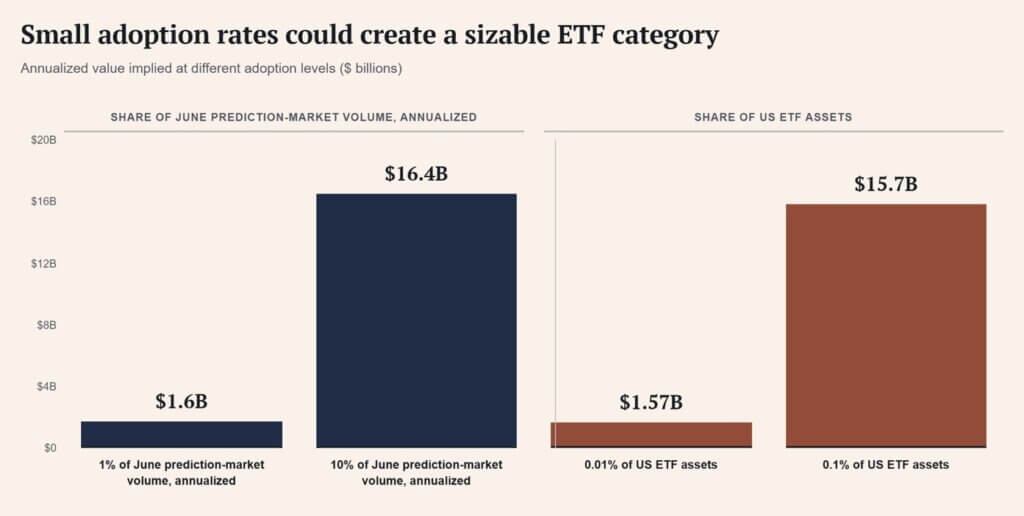
Annualizing June’s volume figure, a 1% migration of that trading activity into regulated ETF channels amounts to roughly $1.6 billion, and a 10% migration reaches close to $ 16.4 billion.
Total US ETF assets were $15.7 trillion as of the end of May, meaning even 0.1% of that base landing in prediction market ETFs would put the category near $15.7 billion.
Regulators with different jobs
The SEC’s review centers on the wrapper itself: fund mechanics, valuation, settlement risk, liquidity, and whether ordinary retail disclosures capture a product that behaves closer to a binary derivative.
The CFTC regulates the event contracts these ETFs would hold. In June 2026, it proposed new rules for reviewing self-certified prediction-market contracts tied to areas flagged by the Commodity Exchange Act, including gaming, war, terrorism, and assassination.
The CFTC said self-certified event contracts have surged, prompting it to examine manipulation risks, settlement weaknesses, and the misuse of non-public information.
| Regulator | What it oversees | Main concern | Why it matters for investors |
|---|---|---|---|
| SEC | The ETF wrapper | Fund mechanics, valuation, liquidity, disclosures, retail suitability | Decides whether event exposure can appear as a brokerage-account ETF |
| CFTC | The underlying event contracts | Public-interest review, market integrity, manipulation risk, settlement integrity | Decides whether the contracts underneath the ETF are acceptable |
| ETF issuer | Product design and disclosure | Explaining binary payoff, early determination, swaps, and loss risk | Determines how clearly investors understand what they are buying |
| Brokerage platforms | Distribution to retail users | Whether the product looks too much like a normal ETF | Controls how easily ordinary investors can access the trade |
What comes next
In the bull case, approval turns election-, macro-, and threshold-linked funds into liquid products, opening prediction markets to brokerage accounts, much as Bitcoin ETFs opened crypto to mainstream investors.
Investors can express a view on an event straight from a brokerage app, and that same convenience can dull the sense of how binary the payoff structure is.
In the bear case, unresolved settlement and investor-protection concerns keep the category stuck in regulatory limbo long after the original filing window.
Prediction markets keep expanding through platforms like Kalshi, Robinhood, and Interactive Brokers, and event contract exposure stays confined to those specialized venues, well short of ordinary ETF shelves.
Prediction markets have spent years building a case for themselves as forecasting tools, and an ETF approval would carry that argument into every brokerage account already holding stocks, bonds, and Bitcoin funds.
That leaves the SEC and CFTC with an awkward question: should a fund that can be wiped out by one yes-or-no bet sit beside the diversified products investors expect to find on the same shelf?
Credit: Source link