
SEC’s latest crypto rules only open a few of Wall Street’s ‘million doors’
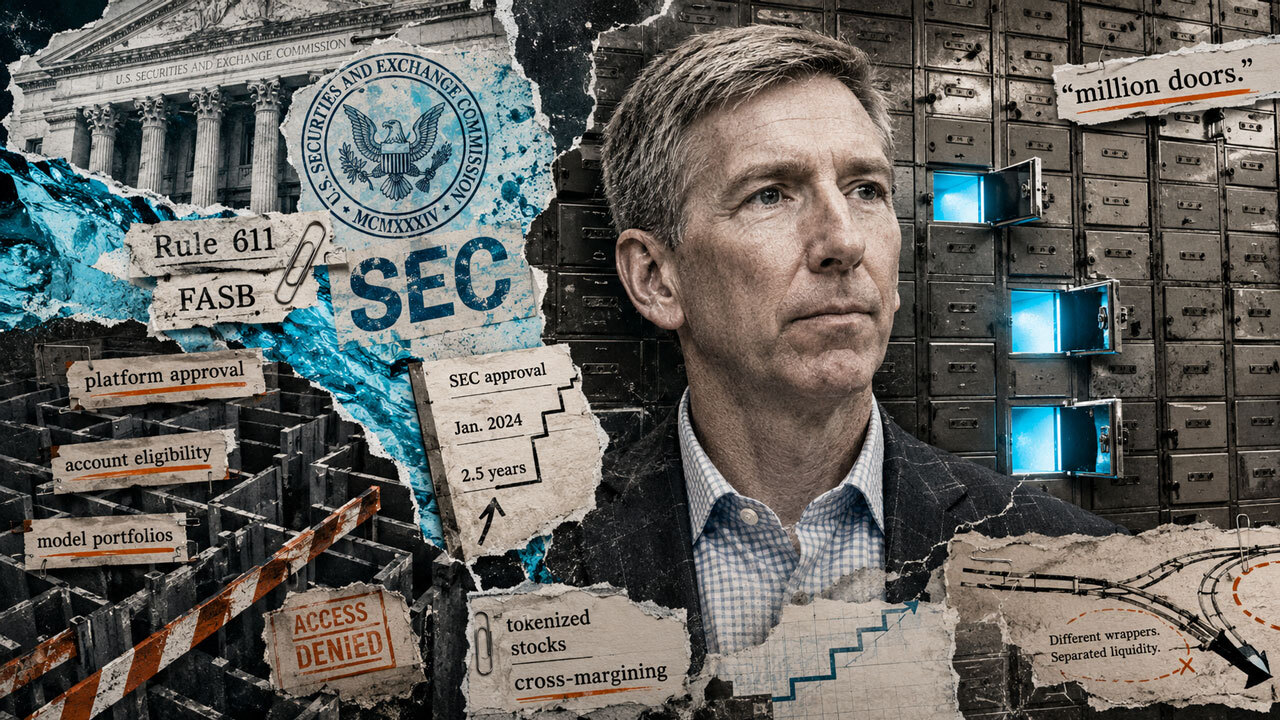
Bitwise CIO Matt Hougan doesn’t think Washington’s crypto-friendly turn is the moment that completely unlocks Wall Street.
In an interview with CryptoSlate, he described the real barrier as something far less dramatic than a single landmark bill. The “brutal real answer” is that it comes down to a million small steps, and some of them are deeply unsexy.
The SEC unveiled its Regulation Crypto Assets proposal on Aug. 18, describing a fit-for-purpose framework for certain crypto investment contracts with exemptions reaching up to $75 million over 12 months.
A day later, President Donald Trump used a White House crypto event to push the CLARITY Act. He said CFTC Chair Mike Selig was working to bring Hyperliquid into the U.S. in a fully compliant, legal way.
A good week for crypto that is only the start
Hougan called this stretch a good week, pointing to the SEC proposal, the Hyperliquid comments, and a Financial Accounting Standards Board proposal. That FASB project could clarify whether certain stablecoins qualify as cash equivalents.
He argued that the industry needs to stack dozens of weeks like this one before institutions treat crypto rails as ordinary financial infrastructure.
Hougan’s clearest illustration came from Bitcoin ETFs. The SEC approved spot Bitcoin ETP listings in January 2024, and the initial reaction assumed the door had opened for everyone.
Large wealth-management platforms still needed to approve the products individually, then decide which account categories could hold them, then clear internal sign-offs. Only then would they consider adding them to the model portfolios that drive most advisor-directed money.
Morgan Stanley and Bank of America both expanded crypto access for wealth advisers only within the past year, and BlackRock added its Bitcoin ETF to model portfolios more than a year past launch.
Hougan’s read is that it took roughly two and a half years for Bitcoin ETF access to move from technically true to genuinely true. He expects crypto’s broader regulatory unlock to move through the same layers.
| Stage | What changed | Why it mattered |
|---|---|---|
| SEC approval | Spot Bitcoin ETPs approved in January 2024 | Legal availability began |
| Platform approval | Wealth-management platforms reviewed and approved products | Advisors still could not broadly use them before this step |
| Account eligibility | Firms decided which client/account types could hold them | Access remained segmented |
| Internal sign-offs | Compliance and product teams added extra gates | Advisors needed operational permission |
| Model portfolios | Products entered advisor model portfolios | Access became scalable rather than one-off |
The trade-through rule as one concrete blocker
Hougan’s specific example was Rule 611, the trade-through rule created under Regulation NMS in 2005. It requires exchanges, brokers, and other trading centers to maintain policies preventing executions at prices worse than protected quotes displayed elsewhere in the market, a structure built specifically for interconnected traditional equity venues.
The SEC proposed rescinding Rule 611 in June, with comments closing Aug. 17.
Hougan argued that the rule stands as a real obstacle to something like Uniswap integrating with brokerage services to serve tokenized-stock investors. Legal analysis of the SEC’s proposal supports that logic, though it doesn’t go quite as far as Hougan does.
Skadden has noted the rescission could still reduce market-structure challenges tied to applying trade-through requirements to trading environments that are not interconnected the way traditional equity markets are.
Hougan said that if Uniswap can compete for tokenized stocks and tokenized bonds, it will do exceptionally well. If Hyperliquid can compete in regulated derivatives markets, the same applies.
Getting there requires a series of regulatory wins, and he said the industry still has more to collect.
Clearing that crypto door reveals another one
If Rule 611 is removed, Hougan’s next concern is fragmentation. Different issuers are building tokenized versions of the same underlying stocks using different structures, different rules, and different chains.
He said:
“A tokenized stock on entity A isn’t the same as a tokenized stock on entity B. Can’t necessarily be arbitraged.”
That means liquidity meant to represent a single stock can split across incompatible pools.
The tokenized equity market capitalization reached roughly $2.8 billion as of Aug. 17, with tokenized stocks climbing to about 15% of the broader tokenized real-world-asset market, close to three times their share at the start of the year.
Separate data put monthly transfer volume for tokenized equities near $23 billion across more than 1.3 million holders.
Hougan remains bullish on tokenized stocks overall, but he expects the space needs standards, normalization, and harmonization before that growth turns into liquidity investors can consolidate and trade against each other.
| Step | Bottleneck | Market consequence |
|---|---|---|
| SEC crypto framework | Issuance rules become clearer | More projects and institutions can build |
| Rule 611 | Legacy equity rules limit broker/DeFi integration | Uniswap-like venues struggle to serve tokenized-stock flow |
| Rule 611 rescission | One integration barrier weakens | DeFi venues can move closer to broker connectivity |
| Tokenized-stock fragmentation | Same stock can exist in incompatible wrappers | Liquidity splits across issuers, chains, and venues |
| Standards gap | Tokens may not be fungible or arbitrageable | Growth does not automatically become unified liquidity |
| Harmonization | Common rules, custody, redemption, and market access | Tokenized equities become easier for institutions to trade |
Where Hougan thinks this leads
Trump’s Hyperliquid comments fit into a bigger structural point Hougan makes about U.S. finance itself.
He said that the “U.S. financial market infrastructure is like a bunch of parallel chains for individual asset classes,” describing separate rails for stocks, bonds, commodities and derivatives that are difficult to move between by design.
In Hougan’s view, tokenization and Hyperliquid-style infrastructure could eventually collapse those rails into financial super apps where multiple asset classes trade side by side.
The concept that could change market structure is cross-margining. Sharing collateral across stocks, bonds, derivatives, and crypto lets capital work more efficiently across a portfolio, instead of holding a separate pool for each product line.
SEC Chair Paul Atkins has independently voiced support for super apps that let a single license cover custody and trading across asset classes. The SEC-CFTC harmonization initiative also includes portfolio margining and cross-margining among its joint priorities.
Hougan’s example of that pattern is stablecoins. The GENIUS Act became law in July 2025, but its core provisions still depend on implementing rules that federal regulators have not finished writing.
Even so, Stripe completed its acquisition of Bridge, Mastercard closed its purchase of BVNK, and Circle expanded its support for Hyperliquid by staking 500,000 HYPE toward becoming a validator. All of that happened before the full regulatory stack settled into place.
Hougan pointed to the FASB proposal covering how certain digital assets could qualify as cash equivalents as another small step in the same direction, the kind of update that shapes balance sheets more than headlines.
The FASB project remains under development, so he argued that institutions do not wait for every rule to be finished. They move once the regulatory direction looks durable enough to justify building, acquiring, and integrating, and that threshold keeps getting crossed one unsexy rule at a time.
Whether the plumbing gets fixed together or piecemeal
The bull case has Rule 611’s rescission, SEC-CFTC harmonization, and tokenized-stock standards advancing together over the next year, letting DeFi venues, brokerages, and stablecoin settlement rails begin interoperating in genuine practice.
Under that path, Hougan’s super-app and cross-margining thesis turns into investable market infrastructure, a step beyond where the argument currently sits.
The bear case is that issuance rules improve while interoperability, margin, and market-access rules lag, leaving multiple tokenized versions of the same assets stuck in separate pools that cannot be easily arbitraged.
| Scenario | What happens | Result for institutions |
|---|---|---|
| Bull case | Rule 611 rescission, SEC-CFTC harmonization, stablecoin rules, and tokenized-stock standards advance together | DeFi venues, brokers, stablecoins, and tokenized assets begin interoperating |
| Base case | Rules improve gradually but unevenly | Institutions keep building, but adoption remains layered and slow |
| Bear case | Issuance clarity improves while interoperability and margin rules lag | Tokenized markets grow in headline size but remain fragmented |
| Structural endgame | Super-apps and cross-margining become viable | Stocks, bonds, derivatives, crypto, and stablecoins trade through shared infrastructure |
In that scenario, tokenization keeps expanding in headline numbers while failing to deliver the unified liquidity Hougan says the market needs.
Hougan makes clear that the plumbing question, the one that decides whether Wall Street can use any of it, gets answered rule by unsexy rule.
Credit: Source link