
Trump says the US could amass ‘sizable’ Bitcoin holdings
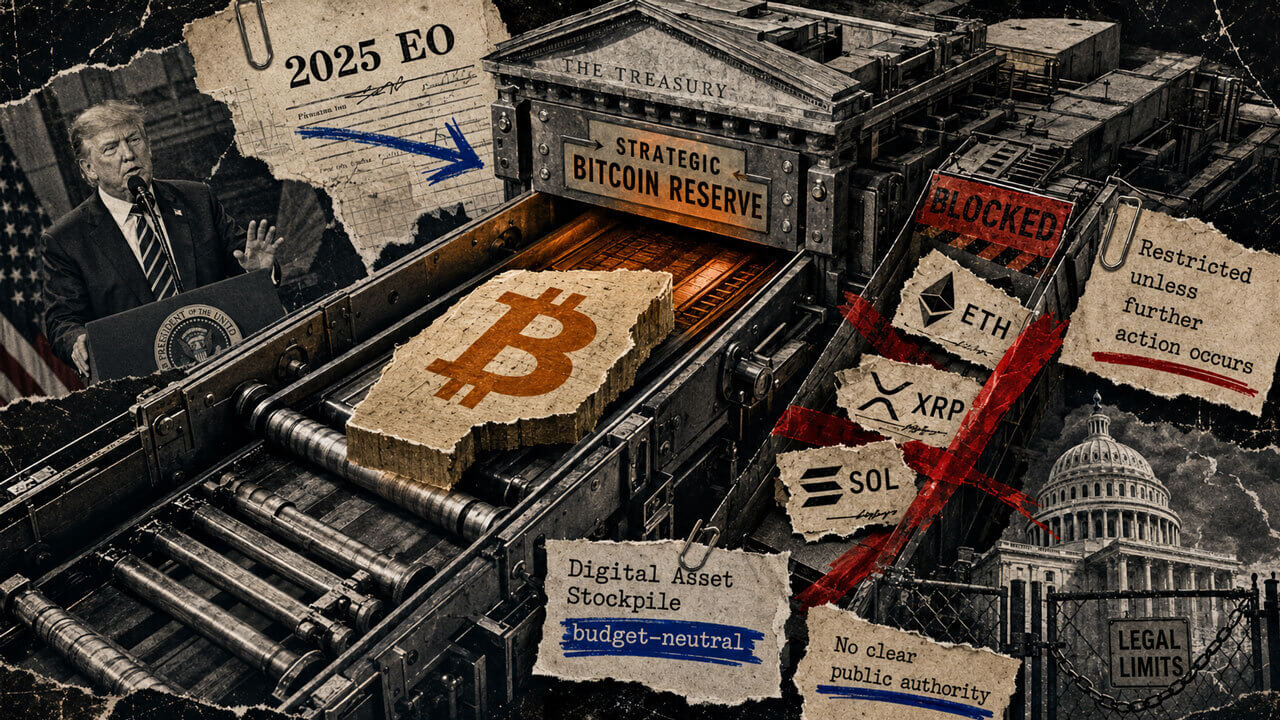
President Donald Trump said on Aug. 20 that the US is considering accumulating sizable amounts of Bitcoin and other cryptocurrencies. Current law gives his administration several ways to increase federal crypto holdings, though no public authority gives Treasury a funded program for multibillion-dollar open-market purchases.
For Bitcoin, Trump’s 2025 executive order already directs Treasury and Commerce to develop budget-neutral acquisition strategies. For non-Bitcoin assets, the same order limits additional acquisitions to forfeiture and civil-money-penalty channels unless further executive or legislative action occurs.
A second executive order could remove that restriction for assets such as Ethereum, XRP, and Solana. Congress would still control federal appropriations and any investment powers that existing statutes reserve to lawmakers.
The 2025 order also requires implementation to comply with applicable law and the availability of appropriations, language that sets the boundary around Trump’s options. A budget-neutral strategy still needs a lawful source of assets or funds, plus authority for Treasury to use them.
The White House’s July 2025 digital assets report said work on operationalizing the Strategic Bitcoin Reserve and Digital Asset Stockpile would continue. The public report identified no approved Treasury program for open-market Bitcoin purchases.
| Action | Bitcoin | ETH, XRP, SOL and other crypto | What still limits Trump |
|---|---|---|---|
| Keep forfeited assets | Already allowed | Already allowed | Final legal title, restitution, forfeiture rules |
| Seek budget-neutral acquisition routes | Already directed by 2025 EO | Restricted unless further action occurs | Must comply with law and appropriations |
| Accept donated crypto | Plausible with Treasury gift authority | Would likely need EO clarification | Gifts are voluntary, not a market-buying program |
| Launch open-market purchases | No clear public authority | No clear public authority | Congress controls spending and statutory investment powers |
| Remove altcoin acquisition restriction | Not needed for BTC | Possible through second EO | Does not create funding or purchase authority |
Forfeitures, gifts and taxes offer the clearest executive routes
Qualifying Bitcoin obtained through final criminal or civil forfeiture enters the Strategic Bitcoin Reserve, while qualifying non-Bitcoin assets enter the Digital Asset Stockpile.
In January 2026, the US obtained legal title to more than $400 million in cryptocurrencies and other assets tied to the Helix mixer case.
Victim restitution, law-enforcement obligations, and forfeiture statutes can also reduce the amount Treasury retains. Trump cannot turn forfeiture into a scheduled acquisition program with a target purchase size.
Section 321(d) of Title 31 gives the Treasury secretary authority to accept, hold, and administer gifts of real or personal property when they aid Treasury’s work.
Bitcoin qualifies as personal property for federal tax purposes. Treasury now administers the Strategic Bitcoin Reserve, giving the department a plausible statutory basis to accept donated BTC into the federal framework.
A supplemental executive order could explicitly recognize gifts as an approved source for the reserve.
That same order could open the Digital Asset Stockpile to donated non-Bitcoin assets. Trump’s current order blocks those additions outside forfeiture and civil-money-penalty proceedings until further executive or legislative action occurs.
Section 6311 of the Internal Revenue Code lets Treasury receive taxes through commercially acceptable means the Secretary chooses under Treasury regulations.
Federal taxpayers currently pay in dollars, and the IRS does not accept digital assets. Treasury could explore regulations that permit Bitcoin payments under Section 6311. The department would also need to determine whether it could keep received BTC in the Strategic Bitcoin Reserve.
The Bitcoin for America Act would expressly allow federal taxes to be paid in Bitcoin and would direct received BTC into the reserve, but the bill has not become law.
These routes could expand federal crypto holdings through assets the Treasury receives directly.
| Route | How it would work | BTC impact | Non-BTC impact | Main limitation |
|---|---|---|---|---|
| Forfeitures | Crypto obtained through final criminal or civil forfeiture enters federal custody | Can grow the Strategic Bitcoin Reserve | Can grow the Digital Asset Stockpile | Timing and size depend on cases, not policy targets |
| Civil money penalties | Crypto received through qualifying enforcement resolutions | Can add BTC without market purchases | Can add non-BTC assets | Irregular and legally case-specific |
| Gifts | Treasury accepts donated personal property that aids its work | Plausible route for donated BTC | Could require supplemental EO for stockpile treatment | Voluntary; no predictable scale |
| Tax payments | Treasury explores accepting BTC under tax-payment rules | Potential future acquisition channel | Current EO blocks non-BTC expansion absent further action | IRS does not currently accept crypto; retention authority unresolved |
| Bitcoin for America Act | Congress expressly allows BTC tax payments | Would direct received BTC into reserve | BTC-specific unless expanded | Not law |
Ideas that run into statutes written by Congress
Treasury could sell ETH, SOL, XRP, or other stockpile assets and direct the proceeds toward BTC, but federal fiscal law complicates that transaction because government receipts generally flow back into Treasury unless another statute authorizes their reuse.
The American Reserve Modernization Act of 2026 would expressly authorize Treasury to sell, exchange, or convert non-Bitcoin stockpile assets and use the proceeds to increase the Bitcoin reserve or reduce federal debt.
The Exchange Stabilization Fund presents a similar obstacle. Section 5302 authorizes Treasury to deal in gold, foreign exchange, instruments of credit and securities for exchange-stability purposes.
The BITCOIN Act would add Bitcoin to that statute and establish a program to purchase 200,000 BTC per year for five years. Congress has not yet enacted those provisions.
Tariff revenue also requires congressional authority before Treasury can use it for crypto purchases. Federal receipts generally enter Treasury, and the Constitution gives Congress control over appropriations.
A president can direct agencies to study a tariff-funded Bitcoin program, but spending those receipts on BTC requires legal authority covering that purpose.
Gold faces two statutory barriers. Treasury gold certificates carry a congressionally fixed value of $42 and two-ninths of a dollar per fine troy ounce. Proceeds from Treasury gold sales are legally directed toward reducing the national debt.
The BITCOIN Act would rewrite the gold-certificate framework and use part of the resulting remittance to finance Bitcoin purchases.
The Federal Reserve offers no current workaround. Its open-market authority covers assets defined by the Federal Reserve Act, and crypto falls outside the current framework. Former Fed chair Jerome Powell previously said the Fed lacks authority to own Bitcoin under existing law.
Trump’s proposed sovereign wealth fund also lacks a funded general investment mandate. His February 2025 order instructed Treasury and Commerce to design a plan covering funding, governance and investment strategy. The order made implementation subject to applicable law and appropriations.
The platinum-coin statute reaches the same fiscal boundary. Treasury has broad discretion over the denomination of platinum coins, but minting one does not authorize a Bitcoin purchase. Congress still controls the legal purpose for which federal funds may be spent.
Congress determines whether Bitcoin accumulation becomes a sovereign bid
The bull case requires lawmakers to turn one of these concepts into explicit purchase authority. A BITCOIN Act-style program could create scheduled acquisitions, identify a financing mechanism, and give Treasury clear statutory authority.
A narrower bill could authorize stockpile conversions, Bitcoin tax payments, or another dedicated revenue channel.
That framework would give markets a federal buyer whose scale and cadence investors could model. Extending the program to other crypto would require additional rules covering eligible assets and funding.
The bear case leaves the federal government accumulating crypto through irregular channels. Forfeitures would continue adding assets when cases conclude, gifts could expand holdings if Treasury formally adopts that route, and tax-payment rules could remain under study.
| Scenario | What happens | Legal requirement | Market implication |
|---|---|---|---|
| Status quo | Government keeps forfeited crypto and studies acquisition routes | Existing 2025 EO | Holdings grow irregularly, with no predictable buying pressure |
| Executive expansion | Trump signs a second EO allowing gifts and lawful non-BTC receipts | EO plus existing Treasury authority | More assets can enter custody, but scale remains limited |
| Tax-payment path | Treasury or Congress enables BTC tax payments | Regulations and/or legislation | BTC accumulation becomes recurring but depends on taxpayer use |
| Stockpile conversion | Treasury sells or converts non-BTC assets into BTC | Congressional authorization is the clean route | Existing crypto holdings could be reshaped into BTC |
| Full sovereign bid | Congress authorizes scheduled purchases and financing | New statute, funding mechanism, investment authority | Markets can model a recurring federal buyer |
Under that outcome, Trump’s latest comments would produce no scheduled federal purchase program. Treasury holdings could still increase, but their size would depend on assets received through specific legal channels.
Trump has room to broaden how crypto enters federal custody. A recurring multibillion-dollar buying program would require Congress to provide the authority, funding mechanism, or both.
Credit: Source link